

Guest commentary: Navigating dry season with conservation mindset
Florida’s water story in 2025 was one of progress, partnership and a shared commitment to responsible stewardship. This past year brought meaningful improvements across much of the system.
Lake Okeechobee saw continued recovery of submerged aquatic vegetation, a key indicator of ecological health. And for another year, the northern estuaries were spared high-volume freshwater releases.
These gains did not happen by coincidence. They reflect the collective efforts of the U.S. Army Corps of Engineers and the South Florida Water Management District — two organizations united in purpose and committed to the long game of restoring, protecting and managing one of the most complex water systems in the country. As we head into the core of the dry season, that partnership remains essential.
We entered the 2025 wet season with Lake Okeechobee lower than usual for that time of year. Recovery Operations and a below-normal dry season left less water in the system heading into summer. While rainfall lifted the lake to just under 14 feet NGVD, that peak was lower than what we typically observe. As Recovery Operations concluded in May 2025, we shifted to a water conservation mindset — a deliberate effort to protect the lake’s recovering ecosystem and to maintain regional water supply and critical environmental flows downstream.
This year, however, we face a markedly different challenge than in the recent past. Rather than an abundance of water, we are experiencing broad, systemwide dryness. Rainfall across South Florida is at approximately 35% of normal. Drier conditions are expanding. La Niña continues to influence precipitation patterns, and forecasts beyond early spring remain uncertain. Every drop of water matters, and we must manage the system with prudence, precision and unity.
Our approach for the coming months is intentionally conservative. We will continue providing low flows to the Caloosahatchee River Estuary at the W.P. Franklin Lock and Dam. We do not plan to send water to the St. Lucie Estuary or Lake Worth Lagoon. Water supply deliveries will move south as needed, with particular focus on late dry-season flows to the Everglades — a period when the risk of muck fires is highest and when environmental needs are most acute.
This strategy reflects our shared commitment to meeting human needs, while working toward ecological health and long-term system stability. This becomes harder during periods of prolonged dryness, but it is never optional. It is the cornerstone of responsible water management in South Florida.
Our teams are closely monitoring all relevant indicators: community needs for sustained water supply, the lake’s recession rate, regional rainfall projections, salinity conditions in the upper Caloosahatchee, and water levels in critical areas such as northern Water Conservation Area 3A. These factors guide our decisions daily.
South Florida’s water management challenges have never been simple, but the progress we’ve made — and the cooperation that made it possible — gives me confidence. We are not navigating this dry season alone. We are doing it side by side with the state of Florida, our tribal partners, local governments, environmental organizations, agricultural communities and the millions of Floridians who depend on this system.
The conditions we are experiencing this dry season highlight the reason for developing the storage components of the Central Everglades Restoration Project (CERP). Replacing lost landscape storage to preserve water availability into the dry season and allowing more natural fluctuations in lake levels are why completion of storage features is so vital to the overall system health and resilience. To that end, completion of storage features, like the C-43 and C-44 reservoirs and acceleration of the EAA Reservoir to 2029, provide the ability to store water in the wet season further limiting the need to use the lake like a reservoir or release volumes of fresh water to tide. These features make water available for beneficial use longer into the dry season and provide insurance against drier conditions like those we are experiencing now.
Our mission is shared. Our success is collective. And our commitment is unwavering. In the months ahead, the Corps will continue working with the South Florida Water Management District and all our partners to sustain the gains we have made, protect the environment we cherish and support the communities that rely on this water every day. Even in a challenging dry season, that work continues — steady, coordinated and unified.
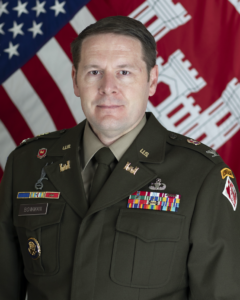
Brandon L. Bowman is commander of the U.S. Army Corps of Engineers’ (USACE) Jacksonville District. The mission of the USACE is to deliver vital engineering solutions, in collaboration with its partners, to secure the nation, energize the economy and reduce disaster risk. For more information, visit https://www.usace.army.mil/.