

Guest commentary: Estuary suffers due to low freshwater flows
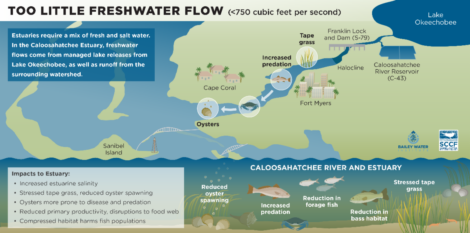
If you’ve been around the waters of the Caloosahatchee estuary recently, you’ve probably noticed how beautiful it looks. The turquoise waters of the Gulf have surrounded our islands, providing picturesque views stretching from the shore to the horizon.
The gorgeous setting makes for a great postcard or social media post, but it belies the disaster that is currently unfolding beneath the surface.
For a healthy estuary, Gulf waters must be balanced by freshwater flows from the Caloosahatchee watershed. Salty ocean water is kept out of the upper estuary by freshwater coming through the S-79 Franklin Lock and Dam. This protects organisms with low salt tolerances in the upper estuary, and creates a large mixing zone for estuarine species that thrive in brackish conditions.
EXCESS SALINITY, CRITICAL HABITATS
Adequate flows through S-79 also ensure the estuary’s salinity balance is in the correct range for critical habitat-forming species like Eastern oysters (Crassostrea virginica) and tape grass (Vallisneria americana). Oysters and tape grass provide vital habitat for countless species, invaluable ecosystem services to our region, and play a major role in maintaining the estuary’s biodiversity and productivity. Salinity levels outside the optimal range for prolonged periods can harm these habitats, requiring multiple years of recovery.
Most of the year, the river is able to provide adequate flows to push out the encroaching saltwater. However, during the dry season, there is not always enough water within the river’s watershed to provide these necessary flows.
When this occurs, it is necessary to make small, managed releases from Lake Okeechobee to keep the water flowing through the S-79 structure at the lower end of optimal — about 750 cubic-feet-per-second (cfs). These are not the massive damaging releases that we associate with brown water choking our estuary and spiking nutrient concentrations, which can reach upwards of 10,000 cfs.
These are instead controlled, beneficial releases that seek to control the salinity of the estuary. Without these releases, the estuary suffers.
While 750 cfs is the lower limit of what is considered “optimal” flow conditions, 457 cfs is the minimum flow level that must be met before multi-year damage occurs in the estuary. As of March 17, the 14-day moving average flow at S-79 was below the optimum flow envelope for 142 days and below the mandated minimum flow level (MFL) of 457 cfs for 109 consecutive days.
ESTUARY NEEDS WATER FROM LAKE
These conditions put an incredible amount of stress on the estuary. As conditions deteriorate and salinities move higher up the estuary, organisms begin to suffer. Sessile organisms that cannot move, such as tape grass, become stressed by the increased salinity and will eventually die.
Generally, mobile organisms are able to relocate around an estuary to find suitable habitat, but in the Caloosahatchee, the Franklin Lock and Dam prevents them from moving further upriver to chase fresh water. Instead, these organisms have their available habitat compressed against the Dam, resulting in stressful conditions and easy hunting for predators.
These impacts are not always going to be immediately apparent. While a major tape grass die-off will be visible, a large reduction in juvenile organisms lost to habitat compression will take years to be realized. And when the questions arise years from now about how we solve the decreased populations, there won’t be an easy answer. The answer relies on action taken today.
The Caloosahatchee estuary needs water from Lake Okeechobee today. The lake is currently sitting in Zone D of the LOSOM regulation schedule, and our water managers have the ability to send much-needed flows to the estuary. Instead of waiting for more damage to occur, they need to act now to try to control the damage.
Please help by asking the South Florida Water Management District governing board to increase flows at the Franklin Lock and Dam (S-79) to the range required for the health of the Caloosahatchee Estuary. To do so, visit https://sccf.quorum.us/campaign/158476/.
Founded in 1967, the Sanibel-Captiva Conservation Foundation’s mission is to protect and care for Southwest Florida’s coastal ecosystems. For more information, visit sccf.org.
To reach SANIBEL-CAPTIVA CONSERVATION FOUNDATION POLICY TEAM, please email