

Sanibel-Captiva Rotary Club and SCCF partner on Mangrove Nursery Project
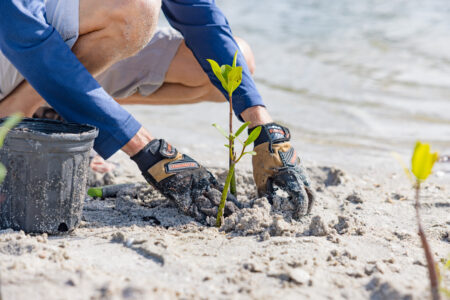
A vision will soon come to life for the Sanibel-Captiva Conservation Foundation (SCCF) due to a grant it received.
SCCF Community Conservation Coordinator Skye McDonald-Newman said the Mangrove Nursery project is one that has been a very long time coming.
The foundation received a $20,000 Rotary District Grant, which will support the new Mangrove Nursery project. The Sanibel-Captiva Rotary Club, under the leadership of President Rev. Dr. Sally Haynes, committed $10,000 to the project and secured an additional $10,000 in Rotary District matching funds.
The Mangrove Nursery will be located on one of SCCF’s properties on Sanibel-Captiva Road, which will be accessible to volunteers, community projects, and volunteer opportunities.
The Mangrove Nursery is the hub of all the programs that SCCF offers with mangroves — Adopt-a-Mangrove, propagule collection, and mangrove restoration plantings.
“We have been making it work at different areas where we can find space,” she said. “We needed a space that functions well for all of these programs we are hosting, as well as an area where we can host education events.”
The new space will provide an area where education events can be hosted with the Sanibel Sea School, and other schools, to teach about mangroves, coastal resilience and ecology of the ecosystems.
McDonald-Newman said they teach them what a plant is, how it survives and how to care for living things.
“We have been searching for a space to bring programs to its full capacity as much as we know we can,” she said. “With the amount of support and interest, we have been really lucky to give the program the attention it deserves.”
Mangrove programs at SCCF are not something new, as the initial restoration work began in the early 2000s for the Silver Key area, which included a ton of community based mangrove planting.
During COVID the Adopt-a-Mangrove program was born, as there were many who wanted to continue to volunteer.
“We needed an option for them to help through their homes,” McDonald-Newman said, as the stewardship would be more accessible to everybody that wanted to participate.
The Adopt-a-Mangrove program offers individuals the opportunity to foster a SCCF nursery potted mangrove seedling. She said individuals can care for it for three months, six months, a year, and bring it back and plant it themselves in one of SCCF’s restoration sites.
“It’s a really wonderful opportunity to get a hands on personal connection to the stewardship we are doing on this island,” McDonald-Newman said.
The next Adopt-a-Mangrove event will be held Friday, Oct. 16, as the mangrove restoration efforts begin each fall. The program begins at 1 p.m.
“That is the first public adoption event of the season,” she said.
Those interested can register through SCCF’s Point volunteer software, https://dash.pointapp.org/events/810388.
The other dates include Saturday, Oct. 24, Saturday, Nov. 21, and Friday, Dec. 4.
McDonald-Newman said the new Mangrove Nursery will not be completed by the first adoption of the season, as they are waiting for the gravel to arrive to get the project started.
“We are really excited. Soon we will announce volunteer opportunities to help build out the nursery and get it to be as fully functional as we dream,” she said, which will include pools, sinks, and other infrastructure needed in a nursery to grow plants and host education programs. “The Rotary will be a huge part of the volunteer event to get the nursery up and running.”
The Hammer Heads, who help nonprofits build an assortment of things, will also help with the project.
“We are excited to get them back on SCCF soil and they are excited to come help with that project,” McDonald-Newman said.
Mangroves, she said, are the most charismatic plant in Southwest Florida. There are three types, which are all incredibly important to the ecosystem.
“They host vast amounts of biodiversity at all levels of the tree structure,” McDonald-Newman said.
She said in the canopy there are coastal birds, foragers, and nesting habitat, while under the canopy there are humans, snakes, frogs, crabs and terrestrial life, and the sea life are found at the mangrove roots.
Mangroves are not only important for biodiversity and hosting wildlife, but play an incredible role in preventing erosion and hosting organisms such as oysters who purify the water.
“Mangrove roots are a great substrate for them to settle on. They help feed the fish and foragers and birds and prevent further erosion,” McDonald-Newman said.
She said mangroves are the “coastline warriors,” as they are the first line of defense during storms.
“All the damage after the storms, in the mangrove forest, are from potential energy caught in the mangrove forest,” McDonald-Newman said.
She said a 2025 study showed that mangrove forests reduced storm surge by 30%.
“A 2025 study found that, in Collier County alone, fringing mangrove forests reduced storm surge by 30%; during Ian, this amounted to $4 billion in prevented flood damage. Being stewards of our coastal ecosystems not only supports a vast biodiversity of wildlife living in mangrove forests but prevents millions of dollars of flood damage to our homes and coastal infrastructure every year,” McDonald-Newman said.
Restoration in and around the island is being done in areas where it was hit the hardest. Although the mangroves naturally rejuvenate, it happens at certain increments.
“It is really important to get mangroves growing back up to be efficient in their function as storm buffers before the next storm comes,” McDonald-Newman said.
Instead of waiting 10 to 20 years for them to naturally rejuvenate, grown plants are being implemented, as they can withstand the wind and wave energy.
This past year 1,800 mangroves were adopted into the community, resulting in 17 community planting events at one of SCCF’s four restoration sites — shorelines on Sanibel, as well as around rookery islands that host a large amount of bird activity, as nesting takes place there.
“They grow up and spend their younger lives there and the older birds come back and nest,” she said.
Without the mangroves it can put habitats in danger — potential habitat loss — at the rookery islands for important shorebird species.
“Every year that changes,” McDonald-Newman said of the restoration sites, as it depends on the need. “We work with ‘Ding,’ the City of Sanibel and other organizations to figure out the areas of the most needs, and what the space looks like to see if it is a good site for restoration.”
SCCF wants to make sure the mangroves will grow and thrive at the restoration sites.
“We go to the sites where our efforts can be best spent and most productive,” she said.
The gratifying part is when volunteers are brought to the sites — the individuals who fostered a mangrove seedling through the Adopt-a-Mangrove program.
“The Adopt-a-Mangrove program is really special. It is such a special thing that not a lot of organizations do. We see it first hand how much it changes people’s perspectives on coastal areas and on mangroves,” McDonald-Newman said of the length of time it takes a mangrove to grow. “That connection is really the basis of the program. It’s wonderful to get that scientific restoration done, and use it as an amazing piece of education for the community.”
To reach MEGHAN BRADBURY / mbradbury@breezenewspapers.com, please email