

COTI official recalls history with Sanibel Plan

Barbara Freeman, first administrator for the Committee of the Islands (COTI) board of directors, recently retired from the position. With COTI’s long history of supporting The Sanibel Plan, it seemed only fitting that, when asked to help it in 2019, she accepted. After all, Freeman has an even longer history with The Plan than COTI does.
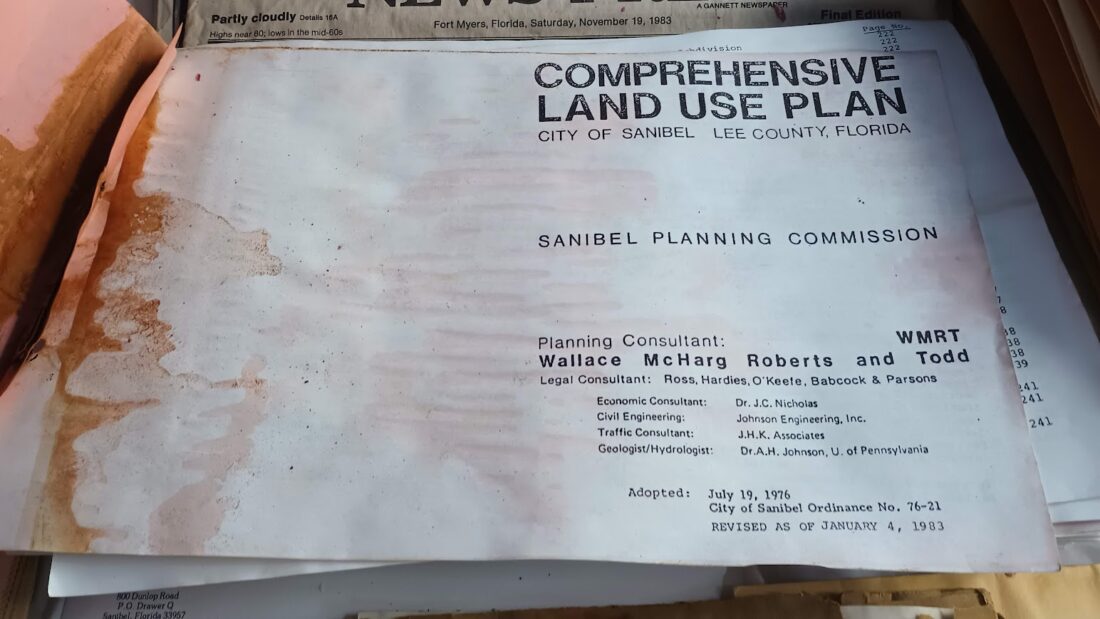
In 1972, not long after graduating from Boston University, she landed a job as administrative assistant to the four managing partners of Wallace, McHarg, Roberts, and Todd (WMRT) in Philadelphia. While renowned for projects across the nation and beyond, WMRT is most familiar on the island for its role in creating the Comprehensive Land Use Plan for Sanibel, aka The Sanibel Plan.
“I initially learned about Sanibel when one of the partners, landscape architect Bill Roberts, returned from the first of his many trips to the island, scattered a handful of gorgeous shells on my desk, and, in his wonderful Welsh accent, waxed poetic about this barrier island,” Freeman said.
WMRT’s work on the multifaceted Sanibel Plan had just begun, and in the subsequent years until its completion, many of the firm’s professionals, including ecological and urban planners, geologists, and landscape architects, would travel to Sanibel and study every aspect of the island in depth. They compiled their findings and recommendations into a far-reaching document they felt confident would guide Sanibel well into the future.
While among them was partner Ian McHarg, internationally acclaimed as “the father of modern ecology,” Freeman explained that they were all experts in their fields and were highly committed to the effort.
“It was exciting to see The Plan take shape and interesting to learn so much about this place called Sanibel,” she said. “I was intrigued and, even after all this time, I’m still proud I was a part of that team.”
It was no coincidence that a few years later, Freeman and her family came to Sanibel, first as visitors and then as residents. She shared her experiences at WMRT when, as a docent at the Sanibel Historical Museum and Village, she taught a class about the creation of The Plan.
“Working for COTI’s board, with their wide range of talents and expertise, and their mission to protect and preserve Sanibel, has felt like coming full circle from my time at WMRT,” Freeman said. “I’m grateful to have had that opportunity and look forward to staying involved and seeing how COTI grows and fulfills its important role in ensuring an excellent future for Sanibel.”
COTI President Bob Moore commented on her retirement.
“Barbara has used her many talents to advance the mission of COTI: to ensure the continuity of good local government, to protect the environment, and to preserve the sanctuary character of our barrier island community,” he said. “Her background in communications and her adept computer skills have assisted us in many ways. We will miss her!”
Even though Freeman has now retired from COTI and has lived off-island since Hurricane Ian, she has by no means lost touch with Sanibel. She continues as executive assistant at BIG ARTS, a position she has held since 2019.
“Now, when I cross the causeway on my way to work, I often think of my connections to this beautiful, unique island,” Freeman said. “While many people have Sanibel roots far, far deeper than mine, I savor the experiences my family and I have had here.”
On Nov. 5, 2024, during the opening of a time capsule 50 years to the day after the incorporation of the city of Sanibel, she reflected again on her history with The Sanibel Plan and her work with COTI, which was established at the founding of the city to protect The Plan.
“Watching as piece after piece of Sanibel’s history was brought out into the light, it was fascinating to see what the city’s leaders and residents wanted the people who would open the capsule to learn about the island and its people and history,” Freeman said. “The most meaningful for me was the copy of The Sanibel Comprehensive Land Use Plan. The hefty, oversized document, which I was probably the one to assemble at WMRT’s offices more than 50 years ago, was a bit battered around the edges; but just like The Plan itself, it has stood the test of time.”