

Good, weak and unknown of tax amendment outlined
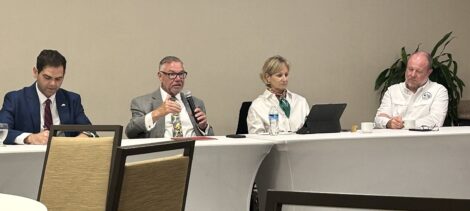
“Do you believe that this contract is going to result on the back end in a benefit for you in the long run or not?” Lee County Property Appraiser Matt Caldwell asked attendees at the Pints and Policy — Property Tax Update after-hours session on June 25 at the Hilton Garden Inn in Fort Myers.
He, along with three other panelists, waded through the vast complexities of the proposed homestead property tax legislation facing voters in November.
The SanCap Chamber and Greater Fort Myers Chamber of Commerce (GFMCC) presented the panel discussion. The other panelists were: moderator, chamber Board Chair and Lee Health Chief of Staff Michael Nachef; Fort Myers Mayor Kevin Anderson; and Sanibel City Councilmember and League of Cities President Holly Smith.
“When people ask me am I for it or against it, I’m really in the position of saying, here are the good things in it. Here are the things that I think are weak points. And here is the unknown,” Caldwell said.
On the good side, he explained that increasing the homestead exemption in 2027 from $50,000 to $150,000 acceptably moves a value set in 2008 to keep up with inflation. On the weak side, jumping that exemption to $250,000 by the following year is extreme.
“That’s a huge shift in how you structure your revenue,” Caldwell said. “And understandably, it’s a little disquieting for folks that have to figure out how to budget.”
As the panelists all pointed out, how cities and counties will make up for the loss of income remains the big unknown.
Anderson, who said Fort Myers keeps the budget “as lean as we can,” talked about possibly raising the millage rate and discontinuing waiving assessment fees for non-profits and churches.
“This is not meant to be a scare tactic. This is numbers, data,” he said.
Smith reported proposals to raise the state sales tax — even though that is not as predictable an income as ad valorem tax. Perhaps new, different types of assessments will result. The National Association of Counties has projected a $3.6 billion loss for 2027-28 and a $6.4 billion loss for 2028 and 2029. That trickles down to a 7.5% loss for the city of Sanibel.
“This contract doesn’t have any performance requirements on the back end,” Caldwell, who described his work as advocating for the taxpayer, said. “There’s no restrictions in terms of the decisions that the local government are going to make, can make, are probably going to have to make, in terms of adjusting the millage, in terms of adopting non ad valorem assessments, in terms of shifting to other forms of taxation, expanded sales tax, tourist tax, et cetera.”
He pointed to other state issues such as overspending, poor organization, and the duplication of city and county oversee as underlying problems.
“The amendment says ‘we’re going to give you a tax break.’ It isn’t really a tax break,” Caldwell said, adding that for many, taxes will increase.
Voters, he said, need to decide on whether or not they foresee an overall benefit from the measure.
“I want to thank each of our panelists for breaking down this head-spinning, complicated issue,” chambers President and Chief Executive Officer John Lai said. “They shared an incredible amount of helpful information and data. The chambers felt it imminently important to organize this special after-hours to sift through all the opinions and some of the misinformation flying around to provide as much perspective as possible from those in the know.”
The event was sponsored by the Hilton Garden Inn.