

City commits funding to SCCF program, coyote study
The Sanibel-Captiva Conservation Foundation (SCCF) reported that on July 21, the Sanibel City Council voted unanimously 5-0 to fund support for its sea turtle and shorebird nest protection efforts and a new coyote population study.
The council voted to include funding for a comprehensive coyote population study and an increased annual contribution to the SCCF’s Coastal Wildlife program in its fiscal year 2026-27 budget — a milestone in the island’s ongoing commitment to protect nesting sea turtles and shorebirds, while better understanding Sanibel’s coyote population.
PRIOR MEETING TO NEW PATH FORWARD
The SCCF reported that the vote caps months of work that began in February, when the Sanibel Coyote Working Group (CWG) — of which it is a member — asked the council to consider a targeted lethal removal effort on the island’s west end beaches ahead of the 2026 nesting season.
The first confirmed sighting of a coyote on Sanibel was at the J.N. “Ding” Darling National Wildlife Refuge in March 2011. Since then, the city’s Natural Resources Department and its partners at the refuge, SCCF and Clinic for the Rehabilitation of Wildlife (CROW) have been striving to monitor and better understand the coyote population on the island.
Working collaboratively as the CWG since 2014, scientists have been closely monitoring the impact of coyotes on nesting loggerhead sea turtle nests. As a federally designated threatened species, loggerheads are protected under the Federal Loggerhead Recovery Plan.
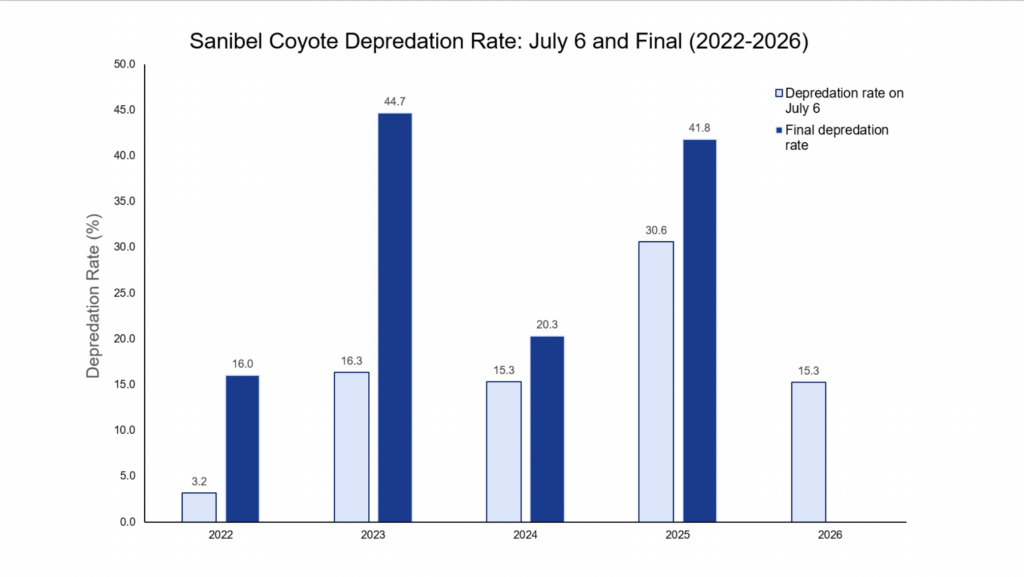
At the February meeting, SCCF biologists who track the coyote depredation rate on sea turtle nests on Sanibel reported that it has been increasing since 2021 and has exceeded 10% for the last four years, exceeding 40% the last two years.
After extensive public discussion, the council declined to move forward with that option and instead asked the city’s Natural Resources Department and SCCF to explore non-lethal alternatives.
In the months that followed, SCCF and city staff met with a range of outside experts — including Humane World for Animals, a representative of the Florida Predation Management Working Group, and coyote researchers from the University of Florida and USDA Wildlife Services — to help identify data gaps and shape a path forward. The SCCF reported that no additional management suggestions beyond those already being implemented by it were identified.
That work culminated in a newly-released city RFP/RFQ for a comprehensive coyote population, spatial ecology and genetics study, the first of its kind since 2015. Proposals are due in mid-August, with a possible study launch in October.
CHALLENGING SEASON ON THE BEACH
The SCCF reported that its Coastal Wildlife team — Director Kelly Sloan, sea turtle biologist Jack Brzoza and shorebird biologist Audrey Albrecht — presented a mid-season update showing predation pressure continuing to climb.
As of July 20, Sanibel’s sea turtle nest depredation rate stood at 17.4%, above the 10% management threshold established under the federal Loggerhead Recovery Plan for a fourth consecutive year, with the heaviest losses concentrated on the far west end between Bowman’s Beach and Blind Pass Beach.
This season also brought a troubling new development: significant coyote predation on shorebird nests, with losses of least tern and snowy plover reaching roughly 72% on Sanibel.
The team also shared results from this season’s mitigation trials. A pilot program testing decoy nests alongside real ones confirmed that coyotes are detecting and investigating the decoys, though it is too early to know whether the tactic reduces actual nest loss.
Larger, heavier-gauge protective screens atop nests did not improve nest protection as expected.
Meanwhile, buried protective cages have grown less effective each year since 2023 as coyotes have learned to dig underneath them, and an experimental habanero pepper deterrent has shown limited success. These strategies were implemented in the past, but not this year.
INDEPENDENT REVIEW CONFIRMS TREND
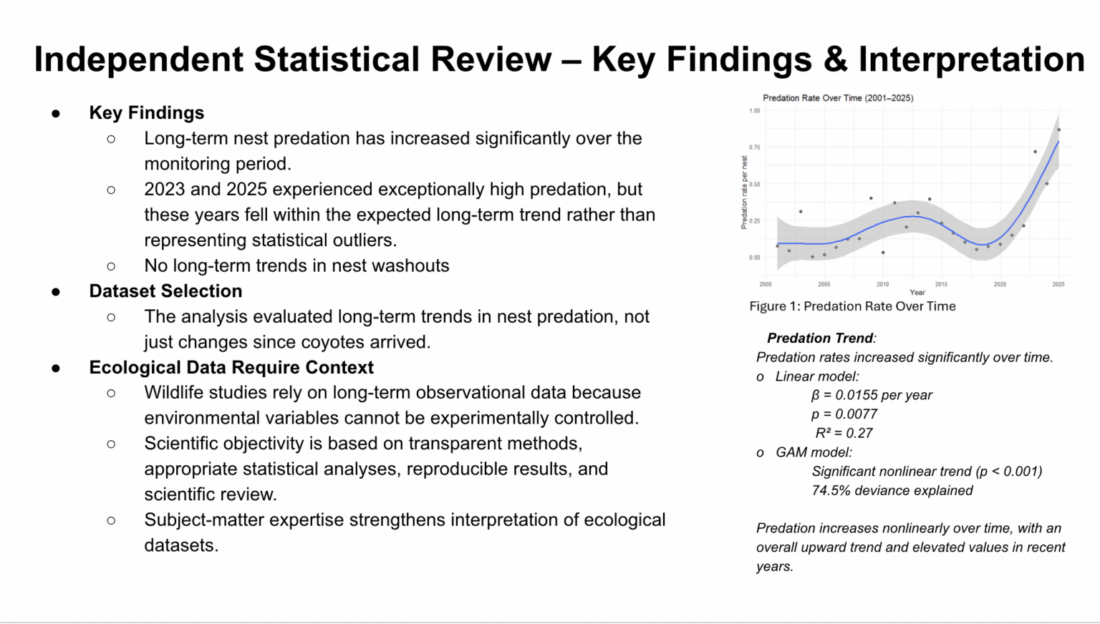
The SCCF reported that an independent statistical review of its long-term dataset confirmed that depredation has increased significantly over time, and that recent high-loss years fit that broader trend rather than representing anomalies.
At the meeting, data presented from July 6 showed that sea turtle nests were experiencing a 15% depredation rate overall, with the far west end reaching 31% versus 7% on the east end, and 177 of the season’s 986 sea turtle nests had already been lost to coyotes; shorebird losses stood at 63 of 177 nests.
Updated data from July 28 now shows a depredation rate of 19.2% across Sanibel’s 912 total nests, 30.8% across Captiva’s 240 total nests, and a combined rate of 21.6% across both islands’ 1,152 total nests.
Brzoza added that depredation rates historically climb from midseason toward the end of the season on Oct. 31 — new nests stop being laid by late July, but the nests already in the sand stay vulnerable right through hatching.
He thanked volunteers for helping to protect and care for island nests.
“This season we have 95 active volunteers, many prominent members of the Sanibel community, contributing roughly 4,000-5,000 hours seasonally,” Brzoza said.
“FWC (Florida Fish & Wildlife Conservation Commission) has told us we’re essentially at maximum capacity and won’t add more volunteers to our permit,” he added.
COLLABORATIVE CONSERVATION EFFORT
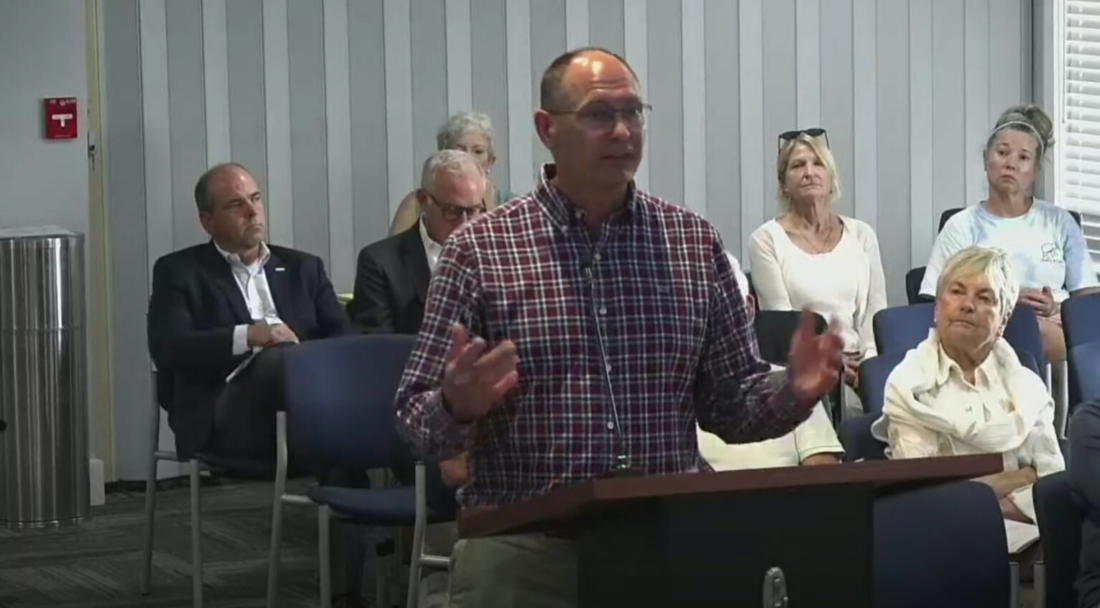
At the July 21 meeting, SCCF Chief Executive Officer James Evans thanked the council and community for their deep commitment to protecting and caring for coastal wildlife.
“The city has been an incredible partner on every front of conservation, and we can’t thank you enough,” he said. “We depend heavily on grants and donors, many of whom are community members, but this support would help us meet the goals of the protection plan. Thank you for your consideration.”
Evans outlined the SCCF’s roughly $329,000 annual investment in the sea turtle and shorebird program and requested that the city contribute approximately 20-25% of that cost going forward — a request that the council ultimately built into its funding decision.
Council members voiced strong support for both the coyote study proposed by city staff and the SCCF funding requests, several citing Sanibel’s identity as a “conservation island.”
Following discussion, the council voted to contribute $75,000 toward the SCCF’s depredation mitigation efforts and to cover the cost of the coyote population study — with early comparable study proposals ranging from roughly $131,000 to $169,000.
City staff also confirmed that, regardless of the broader non-lethal strategy, any coyote posing a direct threat to human safety would continue to be addressed under Florida law — the same standard applied to other wildlife, such as alligators.
NEXT STEPS
The SCCF reported that with the study RFP now live, it and city staff expect to review proposals and conduct interviews through September, with fieldwork potentially beginning in October.
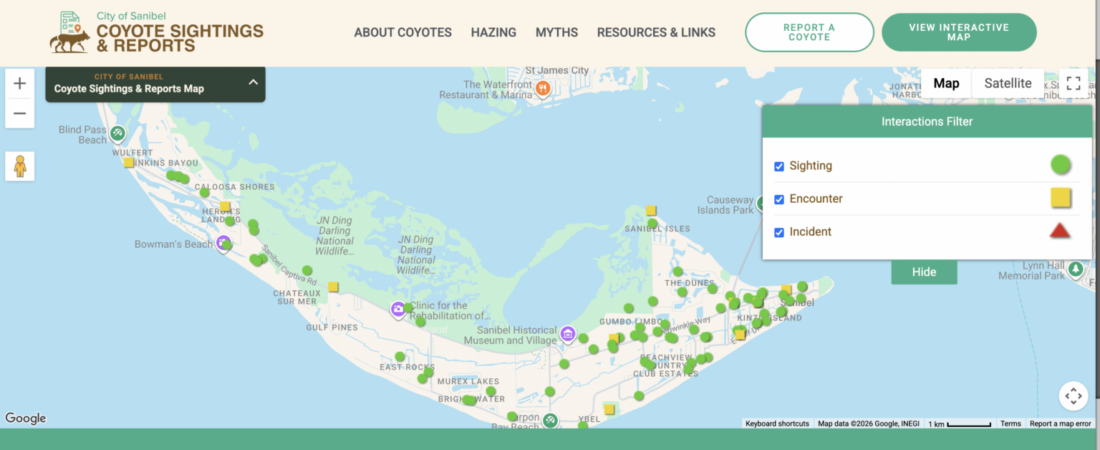
A companion public reporting tool, SanibelCoyote.com, is now live and allows residents to report coyote sightings and access information on coexisting safely with the island’s coyote population.
The SCCF will continue monitoring nests through the remainder of the 2026 season and plans to return to the council after the season ends to discuss findings and next steps — including a possible workshop on mitigation strategies for 2027.