

Construction begins on SCCF intern village
The Sanibel-Captiva Conservation Foundation (SCCF) reported that construction began on its La Gorce Family Intern Village on May 4. The 30-bed housing project will support interns conducting research, monitoring, education and advocacy work.
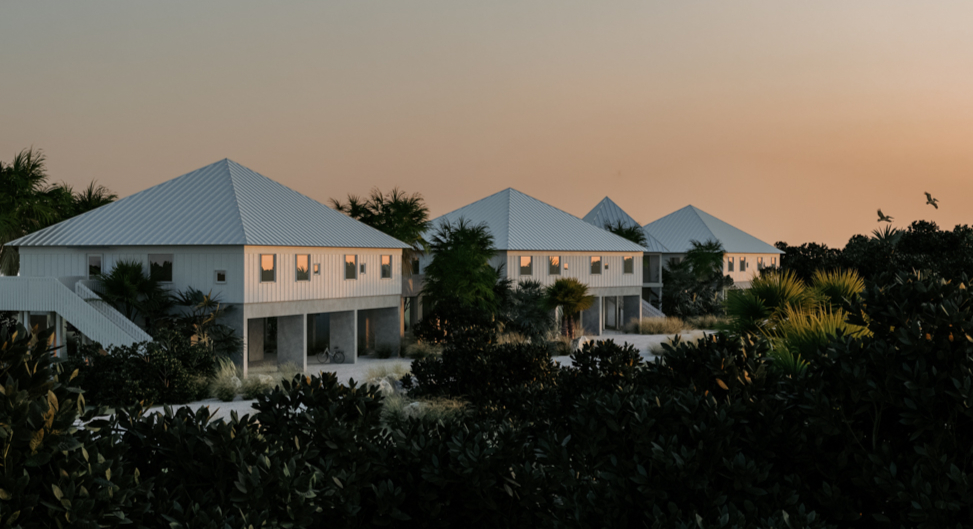
Designed by Boston-based CO-G Architecture with Amy Nowacki Architect serving as local architect, it was created for resilience, featuring three elevated buildings totaling 7,700 square feet of housing. The SCCF and its neighboring partners — the Bailey-Matthews National Shell Museum & Aquarium and Clinic for the Rehabilitation of Wildlife (CROW) — will utilize the housing for seasonal interns.
Stevens Construction started site survey work on the first week of May on the village, which is located on Sanibel-Captiva Road, where the SCCF previously had its intern housing next to its headquarters.
“The La Gorce Family Intern Village is essential to our mission. It allows us to bring researchers, students and conservationists back to the island at a moment when that work is more urgent than ever,” SCCF Chief Executive Officer James Evans said. “After the storms, rebuilding wasn’t just about replacing what was lost — it was about creating infrastructure that supports long-term stewardship of this landscape. This project ensures that the next generation of environmental work on Sanibel has a place to live, learn and collaborate.”
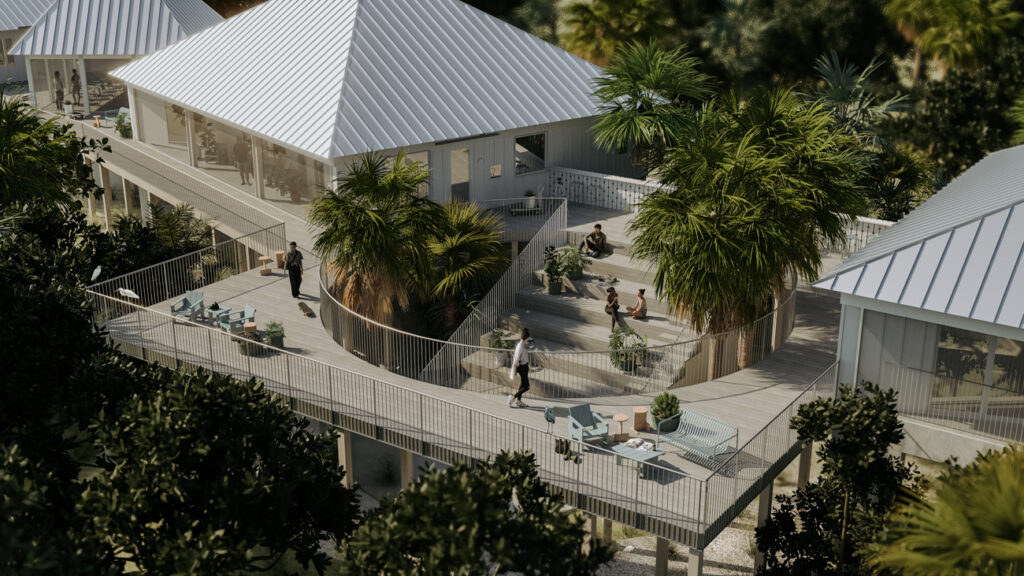
At the heart of the campus, shared structures — an exterior amphitheater, a connective deck and a pavilion — will create a sequence of communal spaces that foster exchange and education. The amphitheater, carved as an oversized circular clearing between two housing buildings, will act as an informal daily living room and a flexible public space for field classes, lectures and performances. The pavilion, conceived as the campus’s family room, will accommodates shared meals, workshops and hands-on ecological learning.
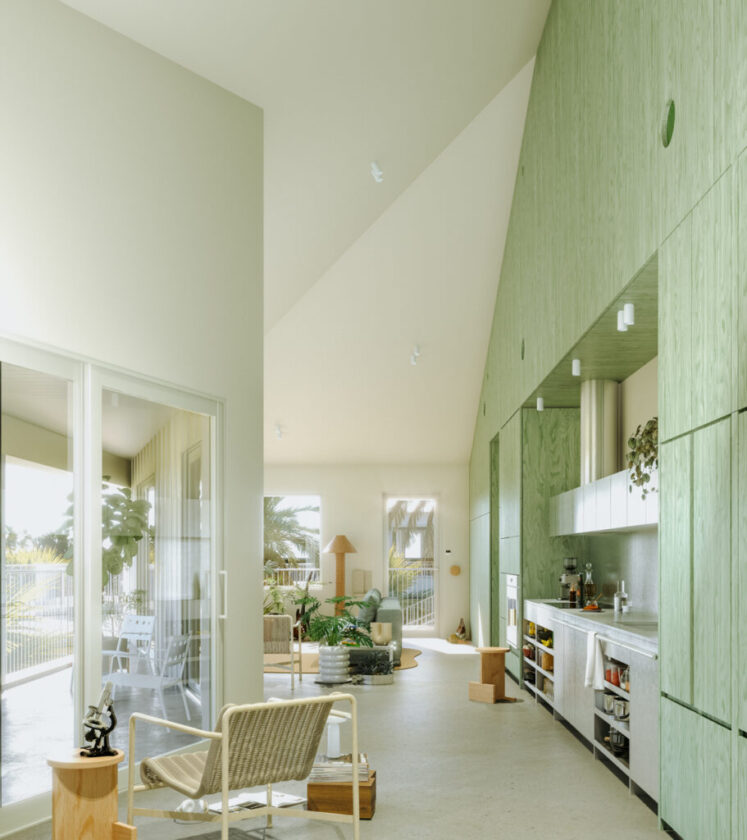
Each housing building is organized around an engaged porch: a recessed, screened outdoor room that will anchor the plan. Shaped as a triangle, the porch will reduce interior corners and mitigates wind pressure during hurricanes. It will increase points of roof attachment and consolidate the vulnerable roof edge to a single side, while deep overhangs will control southern solar exposure along highly glazed shared spaces. The porch will press gently into the shared programs of the plan, introducing spatial differentiation without interrupting continuity. Inside, a wall of green-stained millwork will mark the dramatic vaulted kitchen elevation.
“What makes the village unique is the community it supports. Residents arrive in response to the rhythms of the island itself — whether for sea turtle nesting, migratory bird patterns or coastal research — so the architecture is constantly inhabited in cycles tied directly to the landscape,” CO-G Architecture Principal Elle Gerdeman said.
As part of its construction management services, Stevens Construction spent nearly two years working with the SCCF and architect to design the project in accordance with the city of Sanibel’s building codes, as well as the SCCF’s sustainability and budget goals.
“Building on a barrier island comes with real challenges, from logistics and materials to meeting stringent resilience requirements. This project required close coordination across the entire team to deliver a structure that is sustainable, durable and efficient to construct,” Stevens Construction Principal Mark Stevens said. “We’re proud to be part of a project that not only meets those demands, but contributes meaningfully to the recovery and future of the Sanibel community.”
DESIGNED FOR RESILIENCE
The SCCF reported that with a storm surge approaching 15 feet and extreme winds, Hurricane Ian exposed both the volatility of contemporary weather and fragility of conventional coastal construction. Designed with this in mind, the village’s architectural and structural systems are driven by resilience.
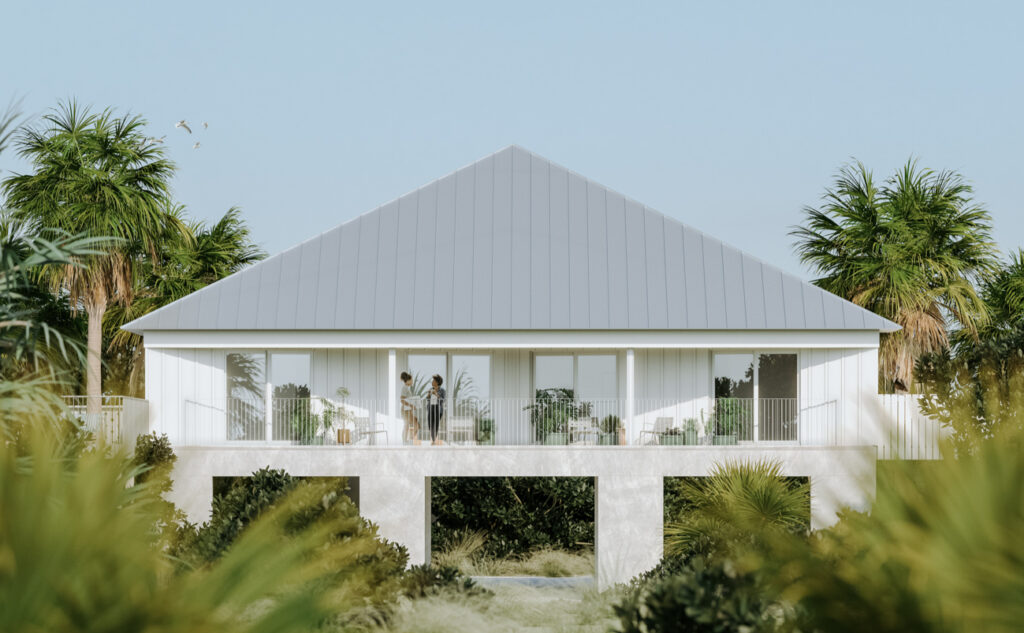
A hip roof will alleviate wind pressure, and the compact rectangular plan will minimize long, exposed elevations. The eaves were kept slight to reduce uplift, while still protecting openings. The buildings were elevated an additional 5 feet above FEMA’s base flood elevation on concrete piers and precast planks, allowing floodwater to move freely beneath. Long rectangular piers will act as shear elements, reducing the need for continuous breakable walls at grade while avoiding costly perimeter moment connections.
“This project began with a simple question: how can architecture on a barrier island accept the realities of wind, water and change rather than resist them? The village translates those pressures into form — nearly square buildings, figured overhangs and elevated structures that work with the climate instead of against it,” Gerdeman said.
“At the same time, we’ve thought about the project as a model for the community: how to retain the familiar character of Sanibel — its porches, screens and informal rhythms — while updating it to withstand increasingly severe storms,” she added.
In its totality, the village will establish a benchmark for barrier-island architecture — adaptive, modest and attuned to its climatic and ecological context. It will operate as both a shelter and field instrument, translating the pressures of wind, surge and shifting climate into a series of compact, elevated forms. Its deep roofs, screened voids and simple geometries will hold both the familiar character of Sanibel and intensifying conditions that will continue to shape it.
“Much of the recent rebuilding, shaped by new regulations and insurance pressures, is trending toward a more generic coastal architecture. This project suggests another path — one where resilience is achieved through the same elements that define Sanibel’s identity,” Gerdeman said.
Architecturally, the project draws from the pragmatic vocabulary of coastal Florida: elevated houses, deep roofs, screened rooms and simple carpentry. Large square windows will align beneath a continuous datum of thick trim tucked under the roof eave. A constellation of smaller operable apertures will punctuate the elevations, recalling the rhythmic ventilation windows of Old Florida cupolas.
The SCCF thanked the following donors who made the La Gorce Family Intern Village possible: Roberta and Philip Puschel, The La Gorce Family, Laurie and Bill Harkey, The Boler Family Foundation, Justine and James Mullens, Sally Wilmeth and Terry Geurkink, Leslie Fleischner, Nancy and Bob Brooks, Elle Gerdeman and Kyle Coburn, and Lisa and Roger Davis.