

Former ambassador analyzes, calls out attack on Iran


Perhaps the administration thought the United States would be treated by the Iranian people as conquering heroes. That there would be parades in the streets for them as Americans came through the center of town.
Maybe the administration thought Iran would simply cave without a struggle or response, and that the United States would simply change the regime with what resembles a democratic style government.
Whatever the case, things have not turned out as the U.S. government planned, because in war, it almost never does. And due to a lack of strategy and anticipated, things have been done incompetently.
That was the assessment made by former U.S. Ambassador Peter Galbraith as he spoke at BIG ARTS’ Conversations Speaker Series on March 19 on Sanibel.
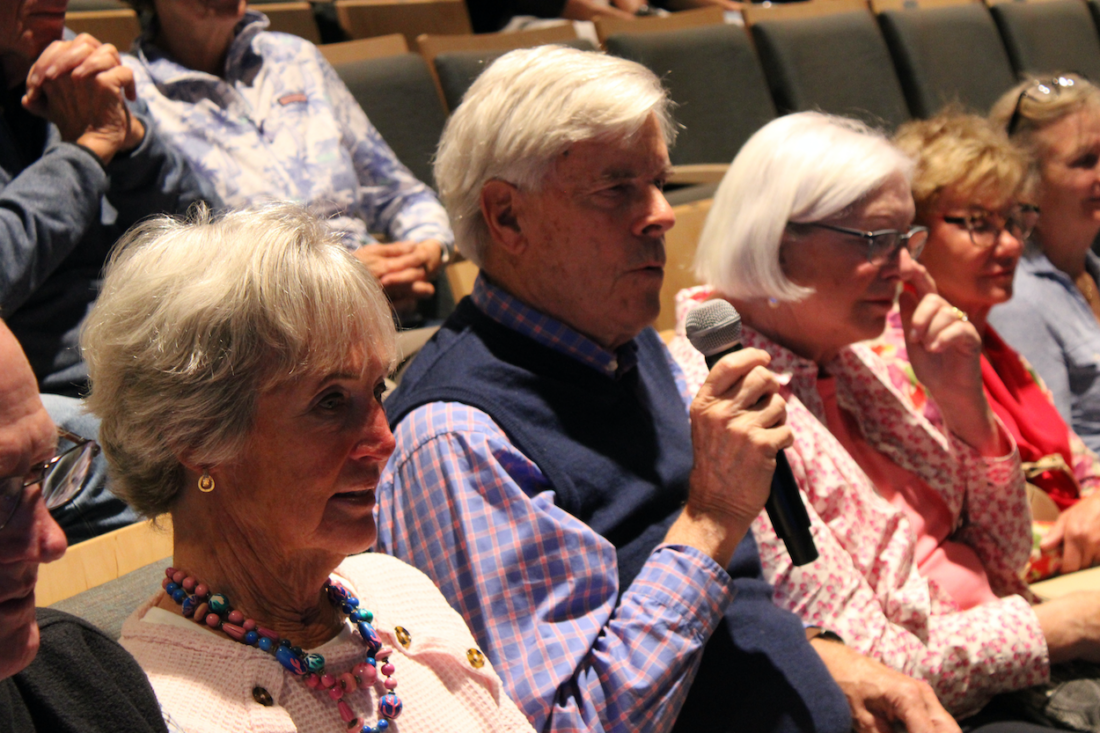
Hundreds came to hear what the expert on the Near East and South Asia, who spent much of his career dealing with wars and post-conflict situations, had to say about the attack and to ask questions and speak with him after to get a more personal dialogue with a man who has spent most of his life dealing with wars and post-conflict situations.
Galbraith started by asking two questions that he said should have been asked before the United States decided to go after Iran: Will it work and achieve U.S. objectives? And are the objectives worth the cost in lives, money, alliances and reputation worldwide?
His main point is that wars rarely turn out as planned; history is littered with wars that those who start them believe will be over quickly, only to find the war lasts for years with lives and capital gone.
“George W. Bush thought his 2003 war with Iraq would be quick and now we still have troops in Iraq,” Galbraith said, adding it is $5 trillion later.
Wars also have unintended consequences, and in war, the enemy always gets a vote. He said the Russian War with Afghanistan and Iran Revolution in 1979 eventually led to 9/11, and that we always have to deal with the enemy as Iran has told the United States how it feels about our actions.
In a moment that brought a chuckle to the audience, Galbraith added that it helps to know a little about the country one is attacking. He said that happened when George W. Bush invaded Iraq in 2003.
“They, the people in Iraq they invaded, were called Iraqis. Iraq is inhabited by 20% Kurds, who are offended if you call them Iraqis,” Galbraith said. “The result was to turn the government over to Shiite religious parties.”
As a result, Iran’s closest ally is Iraq. He noted that before 2003, Iran and Iraq were bitter enemies, entirely because of the United States.
According to President Donald Trump, the objectives of the war are to eliminate Iran’s nuclear threat and ballistic missiles, regime change — which has been walked back — and unconditional surrender.
Galbraith said there was a deal with Iran regarding nuclear capabilities in 2016. Trump withdrew from that deal in his first term in 2018, despite Iran honoring the agreement and objection from allies.
He added there was no evidence Iran had produced a weapon or missile that could reach the United States or had nuclear capabilities. Israel attacked Iran last year, when Trump said Iran’s nuclear program was “completely obliterated,” only to say months later that Iran’s nuclear program was an “imminent threat.”
“Has the United States achieved the goal of eliminating Iran’s nuclear program? Yes. Like Bush achieved the goal of eliminating Iraq’s weapons of mass destruction,” Galbraith said.
Experts say Iran is almost a decade away from having a missile that could hit the United States, but without a nuclear warhead, it is practically worthless. Therefore, no imminent threat.
He said regime change has been the objective for Israel and the neocons in the United States. As for unconditional surrender, that has not happened.
As for cost, Galbraith said few American lives have been lost, but many Iranian lives have. Also, monetarily and reputationally, the cost has been huge.
“The United States is using expensive weapons to attack targets to shoot down inexpensive Iranian weapons,” he said. “It turns out it’s a good idea to consult your allies before you undertake military action. This was as big a surprise to our allies as it was to Iran.”
The war has ravaged the economy. Oil is at $110 a barrel and gasoline is $4 a gallon and rising in a country that depends on fossil fuel for energy, meaning everything will go up in price.
This is where the enemy gets a vote, he said. Without a strong military, Iran has closed off the Strait of Hormuz, which supplies 20% of the world’s oil. It has blown up some strategic areas in other countries, including a natural gas supply in Qatar, and it has done as much as $130 billion in economic damage. It cost Iran pennies on the dollar to use the drones.
Galbraith said people look at Iran in a cartoonish fashion. It is a country with a rich culture and somewhat freer than North Korea. Iranians do realize it is a dictatorship.
America’s misunderstanding about Iran has been the true unforced error throughout this war.
“Iran is really a complex country. We’ve bitten off a lot here. It’s a country five times bigger than Afghanistan, three times the size of Iraq. It’s clear the Trump administration didn’t prepare at all,” he said. “They did not anticipate the Iranian reaction or strategy, which was the only strategy they had, which they executed very well.”
During the Q&A session, Galbraith spoke of the bombing of a girl’s school and the faulty intelligence that led to its bombing.
“We are good at hitting the target we want to hit. We are not nearly as good at knowing what’s there. This kind of incompetence is inexcusable,” he said, adding that it does not qualify as a war crime, provided Israel and the United States had not tried to kill civilians or were reckless.
Galbraith added that the destruction of the oil refineries near Tehran that produced acid rain and toxic chemicals in the air was closer to the edge.
Regarding Russia, he said it wins — another unintended consequence — since oil sanctions have now been lifted.
“We are now funding Putin’s war machine on Ukraine. Iran has allies with China and Russia, who have condemned the attack,” Galbraith said. “Putin has won the chutzpah award for condemning the American attack as an unjustified attack on a sovereign nation.”
When asked what he would do as president, he said he is better at saying what we should not do.
“I would denounce my predecessor as an out-of-control, semi-senile guy. I would come in and engage in negotiations,” Galbraith said. “You can’t have a nuclear weapons program, but we can lift sanctions. Change will be more likely by lifting sanctions and linking them to the outside world, and not isolate them.”
According to BIG ARTS, Galbraith served as the first U.S. ambassador to Croatia, where he negotiated the 1995 Erdut Agreement that ended Croatia’s four-year war for independence. In 2009, he was assistant secretary general of the United Nations for Afghanistan.
While working for the U.S. Senate Foreign Relations Committee in the 1980s, Galbraith uncovered and documented Saddam Hussein’s genocide against the Kurds and was in Iraq during the 1991 uprising against him.
Galbraith is the author of two books on the Iraq War, including the best-selling “The End of Iraq: How American Incompetence Created a War without End.” He holds Pakistan’s highest civilian award for his work in restoring democracy to the country, and he led a Harvard University trip to Iran in 2015.