

New, more resilient roof for marine lab
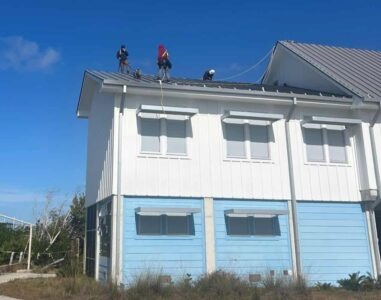
The Sanibel-Captiva Conservation Foundation’s (SCCF) Marine Laboratory has a new standing seam metal roof to make the facility more resilient to future hurricanes.
“The roof was damaged in Hurricane Ian along with some other damage to the fence, siding and ground-level doors,” Marine Lab Director Eric Milbrandt, Ph.D., said.
A high-performance roofing system, standing seam metal roofs’ fasteners are concealed, eliminating potential leak points and reducing maintenance.
The roof repair was completed in December. Other work, including the replacement of the lift, repainting and more repairs, will be done this year. The repairs are being coordinated by the U.S. Fish and Wildlife Service and funded by the 2023 Disaster Supplemental Appropriations Bill.
Designed and built in partnership with the J.N. “Ding” Darling National Wildlife Refuge, the Marine Lab is based on refuge lands in Tarpon Bay on Sanibel.
The lab provides monthly water quality monitoring and annual seagrass monitoring throughout the refuge, including Tarpon Bay, as part of the Memorandum of Understanding (MOU) for the use of the facility at Tarpon Bay. The MOU is valid until 2047.
The Marine Lab’s location on Tarpon Bay gives SCCF scientists year-round access to freshwater wetlands, the Caloosahatchee Estuary, San Carlos Bay, Pine Island Sound, and Gulf. Research focuses on the effects of natural disturbances and human activities on estuaries and coastal ecosystems.
To reach SANIBEL-CAPTIVA CONSERVATION FOUNDATION, please email