

Second egg in Southwest Florida Eagle Cam nest nonviable
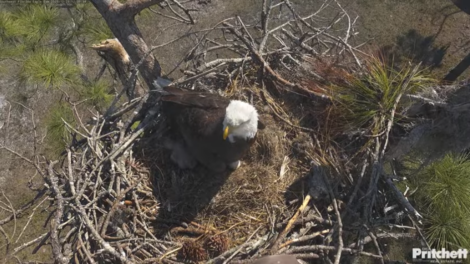
It looks like Southwest Florida’s most famous eagle pair will be raising a brood of one this season after it has become apparent that their second egg is nonviable.
M15’s and F23’s single eaglet, E26, hatched on schedule.
For the second egg, day 40 came and went on Christmas Day without even a pip.
This will be the third year running where both eggs either failed to hatch or hatched but the eaglet or eaglets did not reach the age of fledging.
SWFL Eagle Cam founder Virginia Pritchett-McSpadden said it had become apparent there would only be one eaglet.
“We’ve looked at the different factors thinking the egg would be unviable. We’ll see what plays out in the next couple days,” she said.
That means E26 will get all the attention by both parents in the nest, will not have to deal with sibling rivalry and will grow in a healthy, stable nest, Pritchett-McSpadden said.
“We have mixed emotions because we were expecting that second eaglet. Mother Nature must have had something else in store,” she said.
It is unknown what happened to the second egg. There is no way to tell from the outside if it was just infertile or if something happened during incubation. That could be determined only by examining it, which has not been done since bald eagles are endangered.
Pritchett-McSpadden said the eagles could do a number of things.
“We’ll see them possibly consume the egg for protein or roll the egg out or put it in the bole, the soft area in the middle or cover it up with nesting material and disintegrate in the nest,” she said.
Last year, two eaglets died within days of each other after it was believed they contracted the avian flu along with their parents.
Two seasons ago, the first for M15 and F23, one egg broke days before it was scheduled to hatch and the eaglet did not survive. The other eaglet was able to fledge, the only eaglet with this couple to have done so.
E26 will continue to grow steadily, eventually able to regulate its own temperatures, will lose its down coating and growing feathers, feed itself, and reach the size of its parents within six weeks. After branching and exercising its wings for a couple weeks, it is expected to fledge from the nest sometime in March.
Pritchett-McSpadden called it the “30-30-30,” the time between the hatch and the fledge.
“Over the next 30 days we’ll see huge growth in height and weight. The next 30 days we’ll see them get their feathers and physically change, and the 30 days after that they’ll spread their wings and fly,” she said last year. “It’s the most exciting time and there’s a lot of action in the nest.”
Fans can watch everything in the nest on the Southwest Florida Eagle Cam, which started its 13th season in October as the famous eagles returned home early to work on their nest before mating.
Viewers can catch all the action using four cameras that stream the bald eagles live directly to the site.
Camera 1 is positioned seven feet above the nest and is equipped with night vision. Camera 2 is located at nest level capturing the side view.
Camera 3 is in the nest tree and the first ever live camera in history to capture a 360-degree look into a bald eagle’s daily activity. It allows viewers to click and drag to any viewing area for a fully immersive experience. Camera 4 is installed closer to the pond to capture activity happening around the pasture and in the pond area.
To watch, visit https://dickpritchettrealestate.com/southwest-florida-eagle-cam/.
To reach CHUCK BALLARO / news@breezenewspapers.com, please email