

County board OKs rezoning for Captiva resort
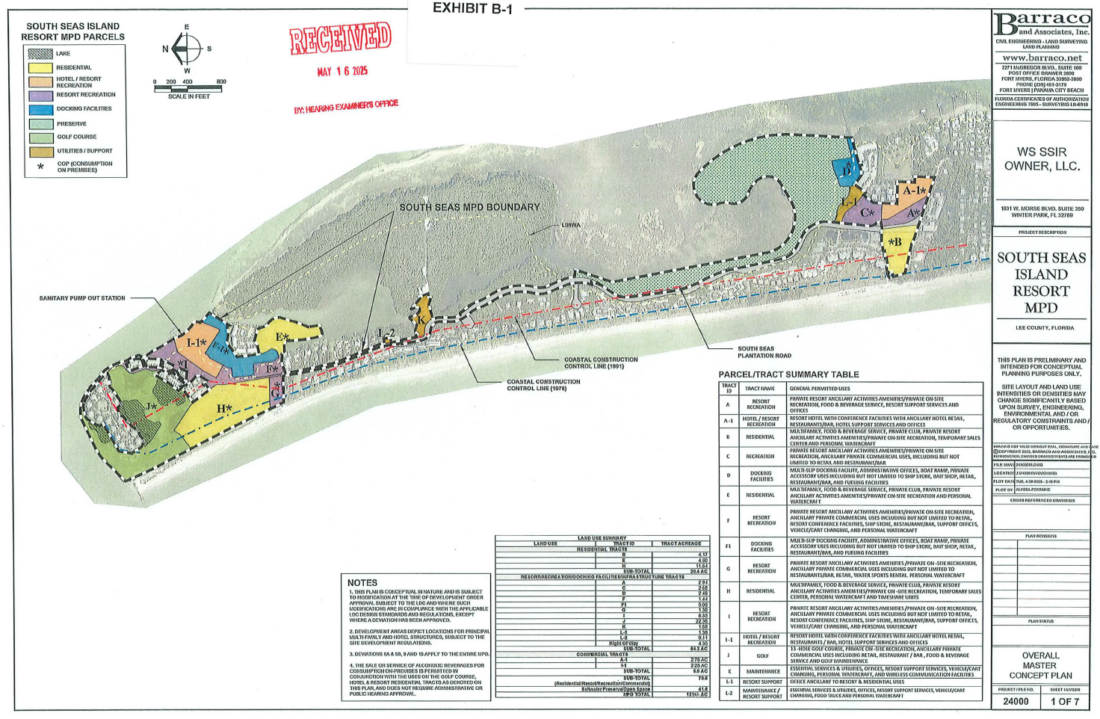
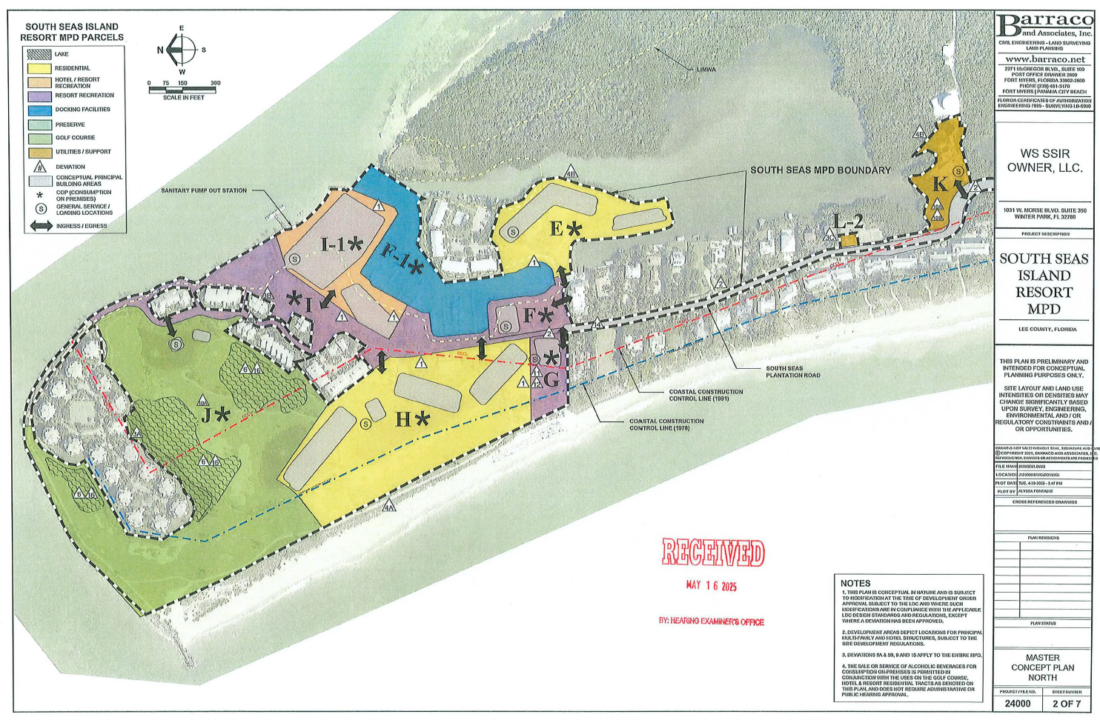
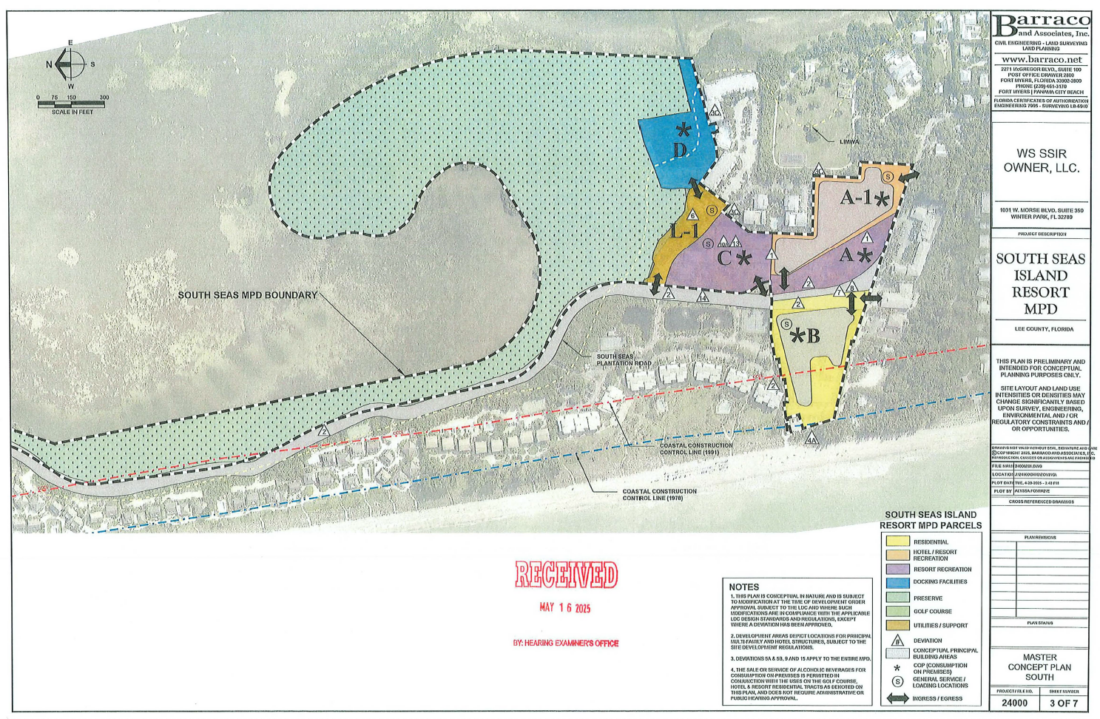
In a split vote, the county commission approved a proposed redevelopment plan for South Seas.
At a Zoning and Comprehensive Plan Amendment Hearing on Aug. 6 in Fort Myers, the Lee County Board of County Commissioners considered a rezoning application from the Captiva resort. In its consideration, it reviewed a finding from Lee County Chief Hearing Examiner Donna Marie Collins, who recommended approval of the request with certain conditions.
Per the application, South Seas requested that about 120 acres be rezoned from Residential Multiple-Family, Marine Commercial and Two-Family Conservation to Mixed Use Planned Development to allow for “a maximum of 193 multiple-family dwelling units and 435 hotel units with accessory uses and structures, common infrastructure, and resort amenities.”
A motion to approve the hearing examiner’s recommendation and the resort’s rezoning application, subject to the 20 outlined conditions, passed 3-1. Vice Chairman Cecil Pendergrass and Commissioners Mike Greenwell and Brian Hamman voted in favor, while Chairman Kevin Ruane voted against it.
Commissioner David Mulicka was not in attendance.
Prior to its discussion and vote, the board heard from the legal team, consultants and officials for South Seas, as well as Captiva and Sanibel officials and attorneys, organizations and citizens in opposition.
Only the 52 witnesses who testified before the hearing examiner could provide comments.
South Seas attorney Neale Montgomery, with the Pavese Law Firm, spoke to past zoning resolutions for the resort and a 2002 administrative interpretation, arguing against a reported cap of 912 units.
“It does not say 912 units. It does not say that hotel units and dwelling units are the same thing,” she said, adding that dwelling units are defined as one’s “normal understanding” of dwelling units.
RVi Planning + Landscape Architecture Vice President of Planning Alexis Crespo highlighted the project, including the Mixed Use Planned Development (MPD) zone and master concept plan.
She reported that the rezoning request is consistent with the Lee Plan and Future Land Use Map, and that the units were calculated based upon the Land Development Code and Lee Plan. She continued that the redevelopment areas will consist of two clusters — one at the south end, and one at the north.
Crespo spoke on the compatibility of the project within the full 300-plus-acre property, describing it as a resort community rather than a “low-density residential community” since over 90% of the buildings are in the rental pool. She offered two examples of the proposed building heights, with one on the south end about 9 feet taller than a nearby building and the north-end hotel about 22 feet taller than another.
“The Lee Plan does not state that buildings have to be the same as each other,” Crespo said. “They have to generally relate to each other in a manner that does not negatively impact each other.”
Additional consultants for South Seas provided comments to the commission on the areas of water quality and monitoring, traffic projections, wildlife and environmental, and utility capabilities.
Barraco & Associates President and engineer Carl Barraco Sr. cited letters from the Island Water Association and Florida Governmental Utility Authority, stating that both confirmed they have enough gallons per day available for the net increases in potable water demands and sanitary sewer flows.
Resort officials, including South Seas Ownership Group President Greg Spencer and South Seas General Manager Shawn Farrell, spoke to the project’s projected economic impact and job creation.
During public comment, those opposed to the rezoning spoke before the commission.
Captiva Civic Association (CCA) attorney Richard Grosso argued that the recommendation of the hearing examiner actually supports denial of the application. He cited the Captiva Community Plan and Lee Code, pointed to violations of the comprehensive plan and statutes, and noted language about enforcing and maintaining what exists in the Code.
“Yet somehow we could interpret those words to mean it’s OK to expand and enlarge. That language means nothing if it’s OK to expand and enlarge,” he said, adding that the HEX recommendation and application ignore the scope and size of the project. “The enormity of decision, the facts that everyone has known for years, the facts that came out in the HEX proceeding, clearly require a denial of this.”
City of Sanibel Attorney John Agnew spoke of how impactful the requested redevelopment increase would be to Sanibel, adding that state land planning laws and intergovernmental cooperation are intended to ensure decisions by one local government do not adversely impact adjacent nearby ones.
“Sanibel and Captiva are fragile barrier islands that have been repeatedly devastated by recent hurricanes. Without a doubt, an approval of this rezoning application would adversely impact Sanibel,” he said, asking the board to acknowledge the multitude of negative impacts the proposed increased density and intensity of use would have and to recognize the “longstanding 912-unit development limit on South Seas and reject this rezoning application.”
An attorney representing eight timeshare associations and 63 additional individuals on the property and a second attorney representing 12 condo associations voiced their clients’ opposition, while pointing out that the rezoning application includes land that it owned or partially owned by their clients, not South Seas.
Sanibel Mayor Mike Miller described the hearing examiner’s report as flawed and inconsistent with the principals of the Lee Plan, while City Councilmember Richard Johnson explained that Sanibel has undergone a significant change since Hurricane Ian, but it has managed it without opposition from the community, while keeping in line with the Sanibel Plan and the overall scope and feel of the island.
Sanibel-Captiva Conservation Foundation (SCCF) staff raised concerns about the capacity to treat the wastewater volume, as well as the environmental impact to local waters and the marine ecosystems.
CCA Board President Lisa Riordan and CCA Land Use Committee Member and Captiva Community Panel (CCP) President David Mintz pointed to the commission’s Code changes two years ago exempting South Seas from the density and building height regulations — despite opposition from both Captiva and Sanibel — noting that county staff stated density and intensity would not increase.
“The South Seas application dramatically increases density and intensity. We’re going from 273 units, which were approved for 50 years, to 628 units, plus the buildings are 20 feet higher than any other building. We’re bringing South Seas’ units from 912, which existed for 50 years, to 1,268 — well over three units per acres. And we’re putting 435 hotel units on five acres of commercial property. That’s 87 units an acre,” Mintz said. “This sets an incredible precedent for future developers to demand the very same right to build on Captiva in the years to come.”
Riordan reviewed the two years of opposition, including: meetings with the board; thousands of emails from residents, businesses and county visitors; petitions from over 13,000 people; and input from the Bailey-Matthews National Shell Museum & Aquarium, Captiva Chapel by the Sea, CCP, Clinic for the Rehabilitation of Wildlife, “Ding” Darling Wildlife Society-Friends of the Refuge, SanCap Chamber, Sanibel City Council and SCCF, along with the 12 South Seas condo and HOAs and eight timeshare associations. That was followed by hundreds of residents speaking at the Code and Plan amendments hearings, then 52 witnesses testifying at the hearing examiner’s hearing, plus 170 submitted statements.
“For more than two years, the Captiva and Sanibel communities have done everything possible to have you understand why you shouldn’t approve the increased density and building heights. The Captiva and Sanibel community concerns have been completely ignored,” she said. “We were forced to file lawsuits and depend upon the courts. That was and is not our first choice. Our first choice is to have our elected representatives represent the people and the communities that elected them.”
“To date, you have failed to do this, instead exempting South Seas from the longstanding regulations on our fragile barrier island and working in, what seems to be to all, a hand-in-glove relationship with one property owner to more than double the permitted density on their property,” Riordan concluded. “Today’s hearing is your last chance to stand up for us.”
Before the vote on the motion, the commissioners offered their comments.
“I think we are a growing community still and I think we have an opportunity to do something special for Lee County,” Greenwell, who was attending remotely, said. “I see no reason to overturn the hearing examiner, so I obviously am for the project.”
Hamman addressed why he made the motion to approve, subject to the conditions and deviations.
“I want the people to know that I absolutely do hear what you say and take into consideration what you say,” he said. “But at the end of the day, I didn’t find the evidence to overturn what the hearing examiner concluded. I didn’t find an error in her recommendation.”
Hamman continued that Captiva is not the same as is was in the 1970s when the prior rezoning resolutions were approved, pointing to the number of timeshares, rental agencies and rental homes.
“There’s an opportunity here to allow something that, I think, is compatible with the way the rest of Captiva operates, to be able to respond to what the market also wants,” he said. “I don’t find what’s going to happen here at a resort, that was already a resort, to be incompatible with the way the rest of the island is used.”
Pendergrass pointed to Ian as the catalyst and reason for the hearing.
“It’s unfortunate it happened, this storm, but we have to move forward. We have to understand that in 1970 or ’73 or whenever it was, this was built,” he said of prior zoning, noting that the board is the receiving government agency for this application to rebuild. “Things change — we have to follow the law.”
“It’s just hard for me to sit here and say that this building, which is still shorter than buildings currently on Sanibel and other parts of the county and other barrier islands, is going to be detrimental to bird life or the water quality or anything else,” Pendergrass added.
A former mayor and city councilmember for Sanibel, Ruane expressed concern with the wastewater element of the application.
“Having governed in Sanibel for 13 years, there were numerous violations of flow in excess capacity, a lot of bacteria in the water,” he said. “I’m struggling with the conversation with wastewater. I’m struggling with the report here, and for that reason, I can’t move forward with this — unfortunately, the math, to me, just doesn’t add up.”
“I just have a little greater insight having governed there and saw the water capacity issues and the excess plant issues that we always ran into, so I struggle with that,” he added. “I do wish South Seas the greatest success, and hopefully I never have to worry about capacity issues like I did for so many years as mayor. It was a frequent, frequent, frequent situation, which I hope we never have.”