

City council provides input on stormwater plan updates
The Sanibel City Council reviewed proposed updates to the city’s Surface Water Management Master Plan post-Hurricane Ian and provided direction for staff on the draft changes at its recent meeting.
On July 30, city staff and consultant Johnson Engineering presented the proposed updates.
Staff explained that the city adopted the first Surface Water Management Plan in 1989, and the last comprehensive update to it was completed in 1992. Johnson Engineering worked on a 2018 update to the plan, but it never received final approval from council.
After the effects of Ian, staff was directed to complete an update of the Stormwater Master Plan to evaluate changes to Sanibel’s hydrologic system and topography, which would be used to guide future stormwater improvements, modifications and operational changes.
Staff continued that the update to the plan includes a full damage assessment of the city’s stormwater system and design of repairs to the system to resolve any issues caused by the storm.
City engineer Oisin Dolley started off the presentation with an overview of Sanibel’s interior wetlands and overland flow. He reported that the island is essentially a bowl and that the system fills and overflows, it does not drain dry. Two interior freshwater basins outfall to the Pine Island Sound via the city’s weirs, and saltwater intrusion occurs when the freshwater head decreases. He noted that it is necessary to retain as much rainwater as possible to maintain the freshwater wetland ecosystem.
Dolley provided a map of Sanibel’s Interior Wetlands Conservation District and highlighted the native wildlife species that rely on the interior freshwater wetlands, including the Sanibel Island rice rat.
He continued that Ian severely damaged the island’s infrastructure and that culverts, inlets and swales were buried, leaving Sanibel more vulnerable to riverine flooding. In terms of post-storm repairs, at least 4,807 culverts, pipe ends and swales were added to map and hundreds of culverts and swales are in the process of being cleaned/dug out. Funding came from a $10 million state stormwater grant.
Dolley spoke about island flooding due to rainfall versus storm surge. Rainfall flooding occurs when streams and rivers exceed their capacity; storm surge flooding is due to the sudden rise in seawater level during a tropical storm. FEMA flood maps show Sanibel is wholly inundated by seawater in the 100-year storm event. He noted that from 1965 to the present, five of the top 10 highest water levels occurred within the last three storm seasons.
Next up, Johnson Engineering representative Jordan Varble reviewed the data collection. In terms of surface water, 14 water level data recorders were installed for the monitoring network. He reported that the basins generally act as a level pool and runoff is efficiently conveyed to the Sanibel River, as it is designed. Surface water levels in the interior wetlands are similar to those in 1977.
On groundwater monitoring, the interior groundwater percolation is still occurring similarly to past observations, going back to 1953. Due to the island’s low-lying profile, there is little to no deep percolation out of the system, which is consistent with The Sanibel Report from 1976.
Varble continued that a water budget estimates the quantities of water entering and leaving the system. Evaporation and evapotranspiration (ET) account for nearly all yearly outflows from the island, not runoff through the weirs. An analysis of satellite imagery of Sanibel using the Normalized Difference Vegetation Index (NDVI) show that Ian had a devastating impact on plant life. He noted that as less water is lost to ET, management strategies may change.
Moving on to the analysis of roadway elevation, Varble reported that 75% of Sanibel’s roads are below the elevation of 5 feet NAVD 88. He provided a roadway comparison between the island and other areas in Florida, including Key Biscayne, Fort Myers, Marco Island, Miami Beach, Naples and St. Pete.
Continuing with roadway elevation, Dolley spoke about sea level rise and resiliency. He reported that the intermediate-low sea level rise projection for 2080 anticipates that 20% of the roadways will be vulnerable to failure. Increasing the minimum roadway elevation to 4.3 feet NAVD 88 would protect all of Sanibel’s roadways through the 2080 intermediate-low scenario.
Dolley also addressed the two-year storm surge events. Minimal flooding occurs today in such events. However, the two-year events are anticipated to significantly worsen over the next 50 years. He reported that the ability to maintain a freshwater system on the island’s interior will grow increasingly difficult with continued sea level rise.
They concluded with the following recommendations:
Specific area projects
– Tradewinds subdivision drainage, Bailey Road drainage, and areas of West Gulf Drive
Road elevation
– Goal of 4.3 feet NAVD 88, which would provide protection through the 2080 intermediate-low sea level rise scenario
Weir policy evaluation
The primary objective of the city’s Weir Control Policy should be to continue retaining as much freshwater on the island as practical.
– Water inside of the basin to be held at least 1 foot above mean sea level (MSL); was at 0.17 feet NAVD 88 last year for comparison
– To account for dry season evapotranspiration losses, need 1 foot above MSL on May 1
– Weirs limit levels to 1.6 feet and 2.0 feet NAVD 88, so there is not the capacity to lower the levels under the current sea level conditions now
– Under high salinity conditions, lowering the levels at the beginning of the wet season may be beneficial to flush salt water from the system
Weir system improvements
– Flap gate addition/modification: Necessary to prevent backflow of the high tides and prevent minor surge events; limited to what height as the island itself has limited perimeter elevation
– Automation of weir gates: Provides the ability to maximize the tides in the overnight periods and dangerous conditions
– Pump stations: Need is related to future sea level rise more than current conditions; would not provide surge protection or increase flow compared to current flows with gates open
During its following discussion, council thanked staff and the consultant for its inclusion of certain elements and data within the report, while also asking that additional information be included.
Some councilmembers had follow-up questions, which staff answered.
During her comments, Vice Mayor Holly Smith pointed out that every municipality in Lee County except for Sanibel has a dedicated stormwater assessment. Bonita Springs recently adopted its.
“Around the state about 100 coastal municipalities have implemented stormwater utility fees and many are in high-risk flood zones in coastal environments where stormwater infrastructure is critical,” she said.
She continued that if stormwater management is a priority for the public, the city may have to consider implementing an assessment so citizens can contribute, in addition to any outside funding like grants.
City Manager Dana Souza reported that storm surge management is not something that the city can really address, but stormwater management is something that the city and its staff can tackle.
He also spoke on the city’s weir policy. He reported that the manager collaborates with Public Works and Natural Resources staff, and all communicate regularly in advance of days of forecasted rain.
“I think that’s working,” he said, noting that the target was lower last year because of all the rain and that the new additional sensors will help staff to better understand how the basins are functioning.
“I want our council and I want our residents to have confidence that we are proactively managing that,” Souza added. “That we are not waiting for streets to be flooding or some severe event before we are talking and actively opening those gates.”
Per council’s direction, staff will make the updates and bring back the plan for final approval.
To view the presentation, click on SURFACE WATER MANAGEMENT MASTER PLAN.
IN OTHER NEWS
– The council voted unanimously 5-0 to approve a proposal from the Bowman Consulting Group to provide construction engineering and inspection services for the Periwinkle Way Milling and Resurfacing Project in the amount of $65,000.
– The council voted 5-0 to approve a $44,825 award from the Florida Forest Service Urban and Community Forestry’s Hurricane Ian Recovery Grant Program for native tree planting and corrective pruning at the Sanibel Community Park and Frannie’s Preserve.
– The council voted 5-0 on a resolution authorizing the Florida Development Finance Corporation’s (FDFC) Commercial Property Assessed Clean Energy (C-PACE) Program within the city’s limits.
Prior to the vote, staff reported that the city was approached by a business seeking financing through the C-PACE program and requested that the city authorize participation in the program to support businesses in recovering from the impacts of Hurricane Ian. The cities of Bonita Springs, Cape Coral and Fort Myers and the village of Estero have already opted into the FDFC program.
– The council voted 5-0 on a resolution approving the forgiveness of the $20,000 Casa Mariposa debt payment for Community Housing & Resources for fiscal year 2026.
– The council voted 4-0 on a resolution approving the bulk purchase rates of reclaimed water for the Sanibel Island Golf Course for a three-year period. It maintains the rate of $0.062 per 1,000 gallons for the first year, increases 3% in the second year to $0.064 and increases 3% in the third year to $0.066.
Due to a business conflict, DeBruce recused herself from the discussion and vote.
– The council held the first reading for an ordinance to amend the Code related to penalties or fines to be consistent with the recently amended fine structure for Shared Path Use violations. The second reading will be held on Aug. 19.
– Following a discussion of the draft legislation, the council held the first reading for an ordinance to amend the Code to extend the deadline to re-establish or “build-back” nonconforming structures and uses. The second reading will be held on Aug. 19.
– Following a discussion of the draft legislation, the council held the first reading for an ordinance to amend the Code to update “Alternative Shoreline Stabilization Project” to “Living Shoreline Stabilization Project,” clarify existing requirements, add example graphics and allow projects on human-made water bodies to be processed administratively. The second reading will be held on Aug. 19.
– Following a discussion of the draft legislation, the council held the first reading for an ordinance to amend the Code to amend the list of permitted uses in the D-2 Upland Wetlands Zone to permit existing multifamily buildings to remain. The second reading will be held on Aug. 19.
– Following a discussion of the draft legislation, the council held the first reading for an ordinance to amend the Code related to the city’s investment policy. The second reading will be held on Aug. 19.
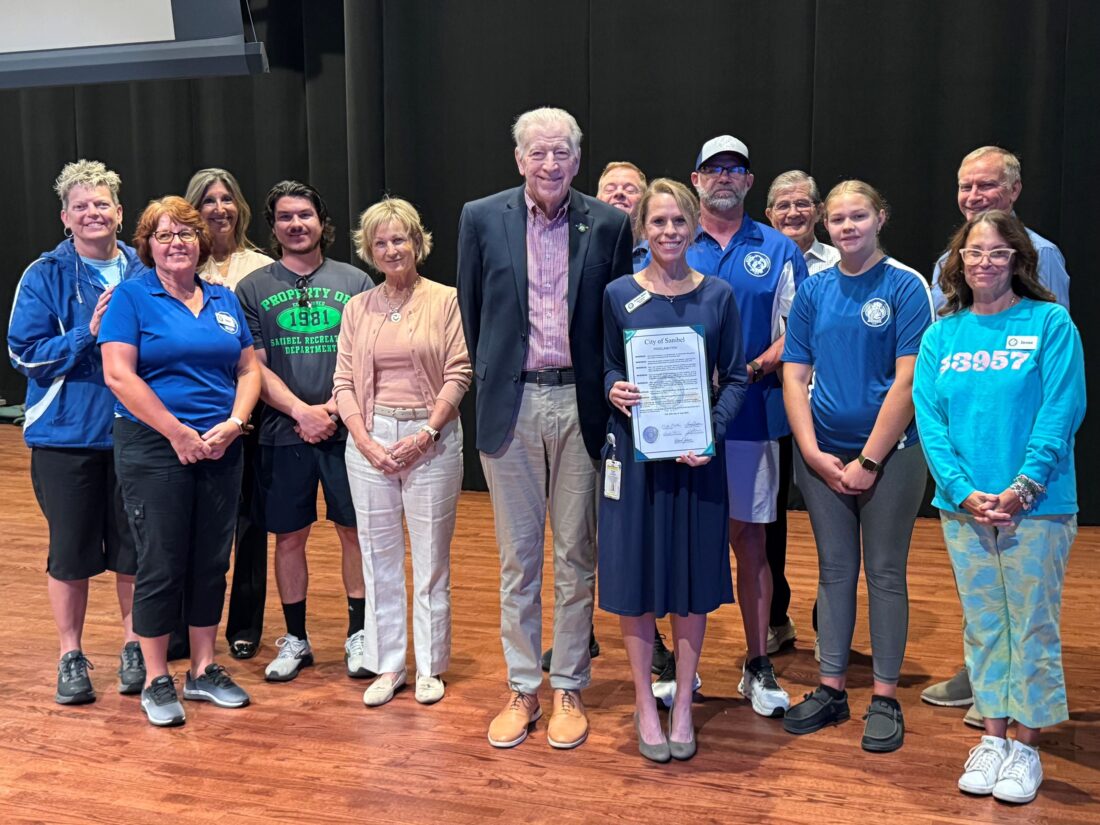
– The council recognized July as Parks & Recreation Month and July 18 as Parks and Recreation Professionals Day through a proclamation.
– The council recognized Human Resources Department human resources generalist Patricia Hotton as the Employee of the Third Quarter for the fiscal year.
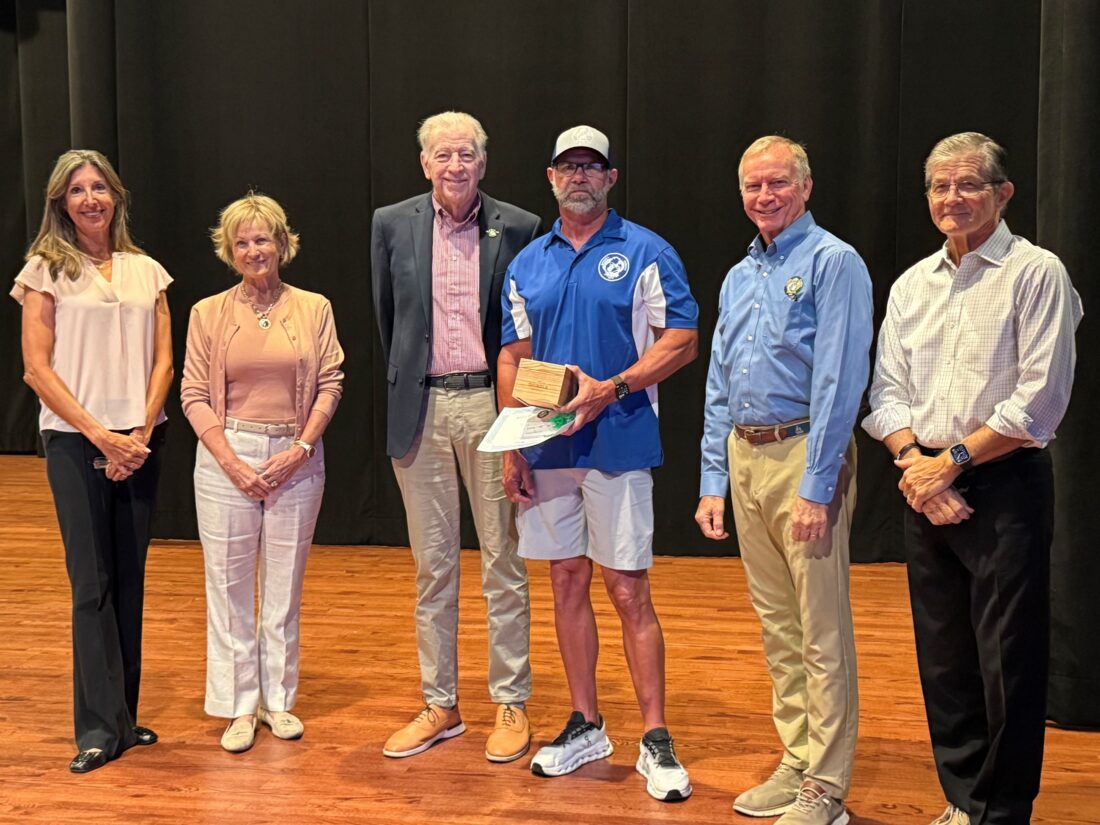
– The council recognized Sanibel Recreation Department tradesworker Billy Ray Holden for his 30 years of service to the city.