

Invasive Species Awareness Week: Mother-in-law’s tongue

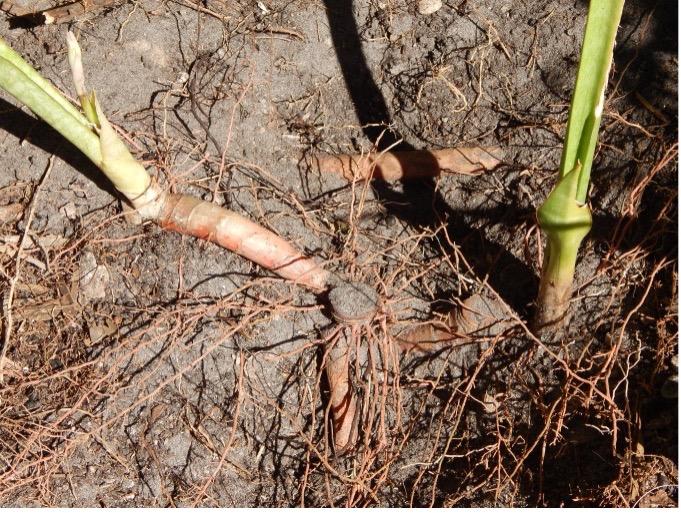
(Editor’s note: As part of the recent National Invasive Species Awareness Week, the city of Sanibel’s Natural Resources Department shared information from the Sanibel Vegetation Committee about a few pesky plants that have made themselves comfortable on the island.)
Mother-in-law’s tongue (Sansevieria hyacinthoides), also known as bowstring hemp or snake plant, is one of the eight regulated invasive exotic plants threatening Sanibel’s natural areas. Originating in the southern tropics and Africa, the plant was used for making bow strings, cordage, ropes, mats and nets. It can thrive in dry climates and rough terrain, but also in moist conditions — virtually anywhere without care. The plant was introduced in Florida around 1800 as an ornamental plant and fiber crop. Growing wild in South Florida, it was deemed a nuisance in 1951 because the stout and creeping rhizomes (a horizontally-growing underground stem that puts out lateral shoots and adventitious roots) eventually produce a dense groundcover that effectively excludes desirable native vegetation.
Mother-in-law’s tongue is a succulent, stemless perennial with long, slightly twisted slender blades. The fibrous blades are green striped with yellow or gray and can be up to 50 inches tall. The plant has a showy scape up to 3 feet tall with tubular white flowers. The rhizome base emerges from the ground as white, but then maturing to bright orange. All parts of the plant are poisonous if ingested.
Because it adapts easily to all growing environments on Sanibel, it is difficult to control. The best removal technique is physical removal by digging. The rhizomes are fragile and break easily when pulled by the leaves. Resprouting is likely if any part of the plant remains and continuous maintenance is recommended. Due to the waxy coating on the blade, chemical combinations are moderately effective, therefore physical removal is best. Any invasive vegetation should be bagged and put out as garbage, not vegetation waste. Good native replacement plants would include wild coffee, stoppers, myrsine and leather fern.
Please remember that mother-in-law’s tongue is only one of the eight regulated invasive exotic plants on Sanibel. The others include Brazilian pepper, earleaf acacia, exotic inkberry, java plum, melaleuca, lead tree and air potato. These species are not permitted to be grown, sold or propagated on the island; upon issuance of a city development permit, they are required to be removed from the parcel, which must be maintained free of these plants in perpetuity.
To view the “Worst of the Worst” invasives and the city’s “The Alien Invasion” brochure, visit https://www.mysanibel.com/content/download/10568/file/The%20Alien%20Invasion%202011.pdf.
For more information, contact the city’s Natural Resources Department at 239-472-3700.