

Agencies share prescribed burn plan for island, offer tips

The Sanibel Island Prescribed Fire Task Force recently outlined its plan for this year’s prescribed burn operations on the island, which will consist of two areas in total if the conditions are right.
At a Community Meeting on March 27 at the Sanibel Recreation Center on Sanibel, representatives from the J.N. “Ding” Darling National Wildlife Refuge and U.S. Fish and Wildlife Service (USFWS), Sanibel-Captiva Conservation Foundation (SCCF), city of Sanibel, Sanibel Fire and Rescue District and Lee County Mosquito Control District gave a presentation on why prescribed burns are conducted and the summer-fall plan. The Florida Forest Service is also a task force partner but was not present.
This year’s targeted properties are the Legion Curve Unit and Botanical Site Unit.
“Ding” Darling Complex Project Leader Kevin Godsea kicked off the presentation by talking about habitat management, explaining that they developed a plan in 2010 for the freshwater spartina marsh or central marsh areas on the island. It aimed to increase the cordgrass vegetation acreage by about 20% and reduce the woody vegetation encroachment by at least 10% through herbiciding and other methods.
“This helps with wildfire mitigation, but we also do this in concert with prescribed burns,” he said.
On prescribed fire versus risk of wildfire, Godsea reported that there have been 15 wildfire events on Sanibel since 1984, ranging from 0.01 acre to about 14 acres. Fire intensity and fire behavior are determined by fuel type, in combination with weather and topography, but moisture level is the most important consideration. Live, green trees and grasses contain moisture, which slows the burning process. He pointed to the wet soil from the wet winter and previous storm surges, noting that although there is dead vegetation across the island, the fire potential is low.
“All of that is very different from our friends out west,” Godsea said. “There is a risk of wildfire out here, but we also have to put it into perspective of we’re not necessarily California either.”
The prescription for prescribed burning entails:
– Predefined management objectives
– Required environmental conditions, including soil moisture, fuel conditions and recent rainfall
– Required weather conditions — both forecasted and actual — including wind speed, wind direction, temperature and relative humidity
He reported that prescribed burns restore hurricane-impacted lands, maintain fire-dependent habitats, improve mosquito control and reduce the threat of wildfire.
On restoring hurricane-impacted lands, Godsea explained that there is mechanical preparation, which includes removing dead trees and opening fire lines, and the prescribed burning removes dead vegetation, renourishes the soil and promotes the growth of new vegetation and germination of seeds.
On maintaining fire-dependent habitats, he reported that spartina marshes are fire adapted and need it to create a mosaic of different vegetation types. Burns produce lush grass with open areas between the grass clumps. In addition, there is wildlife that is dependent on fire. Gopher tortoises rely on open areas for movement, and the Sanibel Island rice rat relies on healthy grasses for food and nesting cover.
Prescription burns reduce the threat of wildfire and increase public safety, reduce hazardous fuels, reduce the frequency and intensity of wildfires, and cause less damage to habitat and wildlife than wildfire suppression activities. In addition, they are more cost effective than wildfire suppression.
Lee County Mosquito Control District representative Robert Scarpantonio explained that prescribed burns are beneficial to mosquito control. They decrease canopy and ground vegetative cover, allowing for increased penetration of spray product and increased visibility for surveying standing water, and result in a reduction in viable eggs with a more efficient use of the insecticides and better applications of the product to larval habitat, meaning decreased larval populations and increased efficacy.
“On behalf of mosquito control, burning is great for us,” he said. “There’s a lot of positive benefits.”
SCCF Wildlife & Habitat Management Director Chris Lechowicz explained that they manage about 1,800 acres on Sanibel, but they have no prescribed burns planned for this year. Dead vegetation removal projects continue to mitigate fire danger, and the replanting of cleared properties is planned.
He reported that current projects include debris removal on Sanibel-Captiva Road on SCCF properties and the replanting of the McGregor properties, West Sanibel River Preserve and Bailey Homestead Preserve. Future projects will include debris removal on the Dayton Preserve at Tarpon Bay Road and West Gulf Drive and restoration of the Valade Preserve on Middle Gulf Drive.
USFWS Assistant Fire Management Officer Brian Pippin unveiled the target map for the year.
“What we have planned to do this year, if conditions are right, would be the Legion Curve Unit. It’s across from the American Legion. Everything north of San-Cap Road,” he said. “And then the Botanical Site (Unit).”
As for when the prescribed burns will take place, Pippin explained that the actual day of a burn cannot be predicted, but they monitor conditions weeks in advance. Another factor is the potential for a burn ban if the fuels are too dry. He noted that they are planning for the prescribed burns in the summer and fall, and that public notification will be sent out several days in advance.
Sanibel Fire and Rescue District Deputy Fire Chief John DiMaria offered the following tips for what the island community can do around their own home in advance of a prescribed burn:
– Bring personal property inside, like lawn furniture, and put vehicles in garages
– Close windows and turn on air conditioner
– Cover pool
– Keep pets indoors
– Stay indoors to minimize impacts or leave the island for the day
“There are very simple things that homeowners or residents can do before and during wildfire events to protect themselves, their property and their neighbors,” he said.
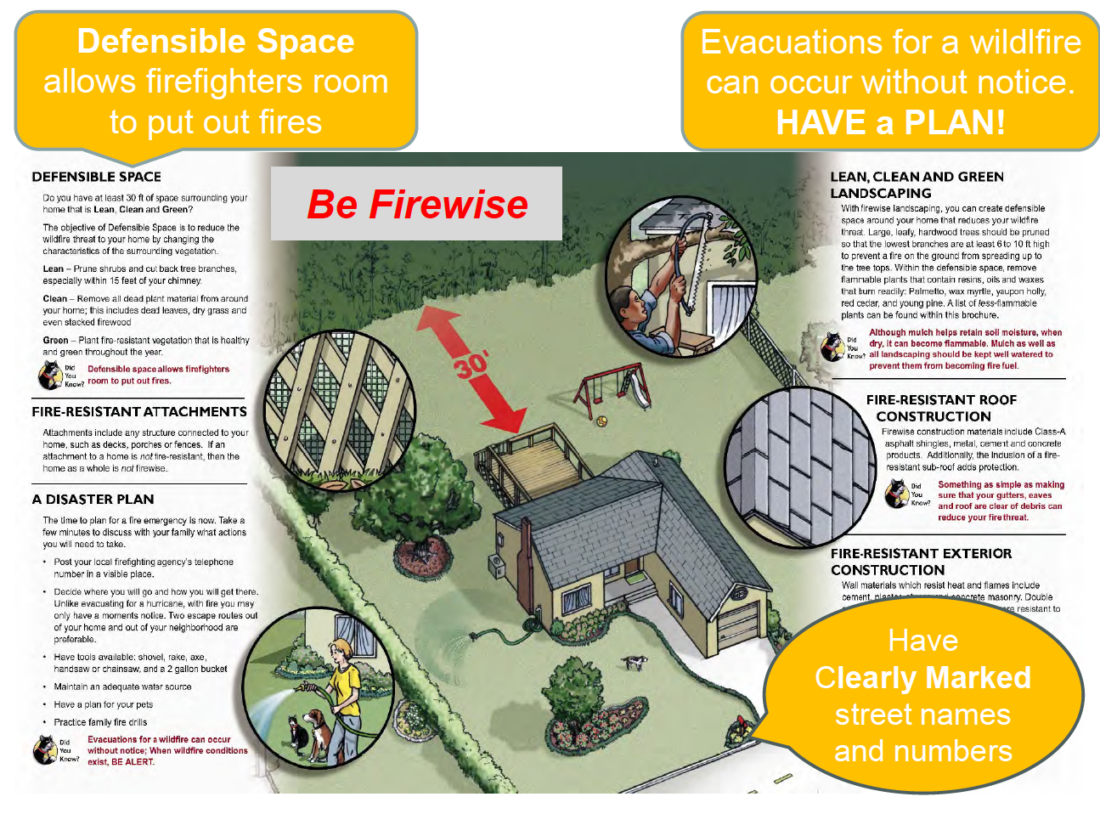
DiMaria also talking about being “firewise” by having:
– Defensible space
– Lean, clean and green landscaping
– Fire-resistant exterior construction
– Fire-resistant roof construction
– Fire-resistant attachments
– Disaster plan
He noted that people should be prepared to evacuate, especially if an uncontrolled wildfire sparks.
“Just like you would prepare for hurricane season, wildfire season is the same,” DiMaria said.
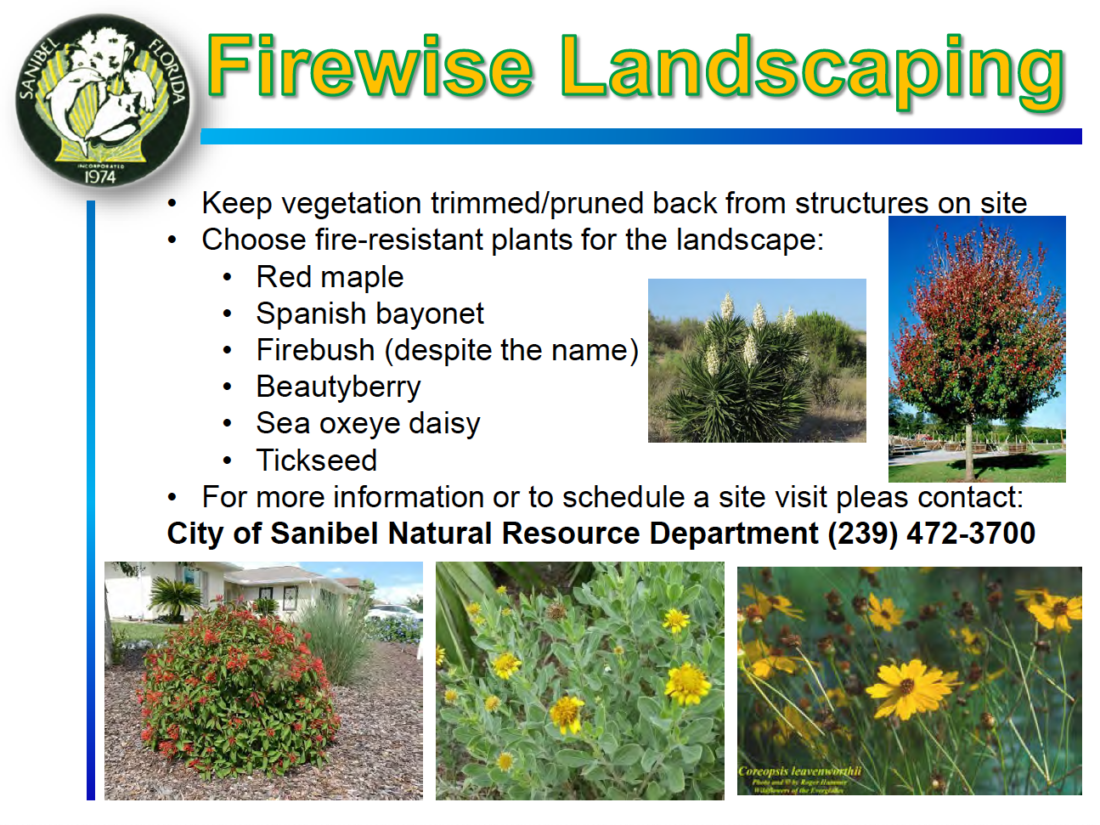
Sanibel Natural Resources Department environmental biologist Joel Caouette explained about firewise landscaping, including keeping vegetation trimmed or pruned back from structures and choosing fire-resistant plants, such as red maple, Spanish bayonet, firebush, beautyberry, sea oxeye daisy or tickseed.
“The city’s role with these prescribed burns lies in the communication aspect,” he said.
Caouette explained that the city will put our press releases and neighborhood flyers when a potential prescribed burn is scheduled, in addition to sharing information on social media. The city also maintains a smoke sensitive list and will contact those on the list about 48 to 24 hours prior to a burn.
The meeting is available to watch on the city’s Facebook page.
To sign up for the city’s announcements, visit https://www.mysanibel.com/.
To register for the smoke sensitive list, contact Caouette at joel.caouette@mysanibel.com.
For more information about firewise landscaping or to schedule a site visit, contact the Natural Resource Department at 239-472-3700.