

Pretty poison: The hidden dangers of tropical milkweed
By SANIBEL VEGETATION COMMITTEE
People are captivated by the beautiful monarch butterfly. The monarch has many threats to its survival, such as habitat loss, pesticide use, and frequent roadside mowing. Concerned gardeners want to help the monarch, but unfortunately some of these efforts cause more harm than good.
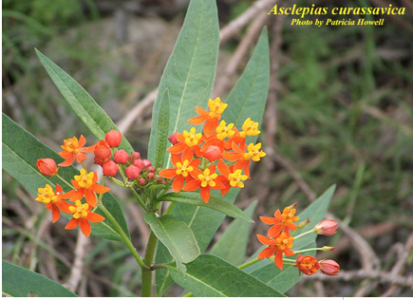
In an attempt to “save” the monarch butterfly, gardeners are planting tropical milkweed, Asclepias curassavica. This nonnative milkweed is listed as a Category II Invasive by FISC, the Florida Invasive Species Council.
Native milkweeds can be difficult to propagate, and because they are a larval food source, butterfly larvae may devour native milkweed foliage before they can be brought to market. Tropical milkweed has exploded in popularity in response to the demand for milkweed by gardeners looking to attract the monarch butterfly. It is easy to propagate, allowing growers to rapidly produce the plant for quick sales. It is an attractive plant, providing flowers and lush green foliage throughout the year, and herein lies the problem.
Tropical milkweed is problematic when planted in warm climates where it does not die back in winter. Ophryocystis elektroscirrha, or OE for short, is a protozoan parasite of monarch butterflies. OE can travel with monarchs visiting the plants and become deposited on leaves. When caterpillars hatch and eat the plant, they ingest the OE. High OE levels in adult monarchs have been linked to lower migration success rates in the monarch population, as well as reductions in body mass, lifespan, mating success, flight ability due to deformed wings, and other developmental issues.
When our native milkweeds go dormant in winter, they break the OE parasite’s cycle and help reduce spore buildup, so that each summer’s monarch population feeds on fresh, parasite-free foliage. Tropical milkweed does not die back; it grows year-round in most of Florida, allowing OE levels to build up on the plant over time and exposing successive generations of monarch caterpillars to dangerous levels of OE. When the infected monarch butterflies feed on tropical milkweed, it allows the OE parasite population to grow.
Tropical milkweed interferes with monarch migration and reproduction. The presence of tropical milkweed in winter encourages monarchs to breed, rather than migrating and overwintering. This disruption of the natural monarch life cycle can cause the monarchs to be exposed to cold snaps, which are fatal to them, and winter food shortages. South Florida has seen a notable surge in its non-migratory monarch population, due in large part to the widespread planting of tropical milkweed and the practice of butterfly rearing, which most times relies upon tropical milkweed. Although well-intentioned, these practices have created ecological and health risks for monarchs. Captive-reared butterflies have compromised genetics and reduced fitness, impairing their natural migration. Rearing is correlated with an increase in disease and parasites such as OE, which is then introduced into wild populations.
Grown as an ornamental plant and often sold as “butterfly plant,” tropical milkweed is often treated with systemic insecticides such as neonicotinoids, which persist in plant tissue and can poison caterpillars feeding on the treated plants. Reduced survival rates, impaired development, and lower reproductive success are the result of exposure to these systemic insecticides.
Emerging research suggests that tropical milkweed may become toxic to monarch caterpillars when the plants are exposed to the warmer temperatures associated with climate change. With warmer temperatures, tropical milkweed produces higher cardenolide concentrations, a type of C23 steroidal organic compound. Monarch caterpillars tolerate cardenolides, as this compound protects them from predation. The issue is that when cardenolide concentrations are high enough, monarch caterpillars cannot withstand them. https://pubmed.ncbi.nlm.nih.gov/41837843/.
Contrast this with the native Asclepias incarnata with naturally lower cardenolide levels, which does not exhibit the same changes in toxicity as tropical milkweed.
So what can you do to support monarch butterflies? Provide fall blooming and year round nectar plants for migrant and resident monarch butterflies such as seaside goldenrod (Solidago sempervirens), dense blazing star (Liatris spicata), sweet acacia (Vachellia farnesiana var. farnesiana), climbing aster (Symphyotrichum carolinianum), snow squarestem (Melantherea nivea), frostweed (Verbesina virginica), mistflower (Conoclinum coelestinum), scorpiontail (Heliotropium angiospermum), yellowtops (both Flaveria linearis and Flaveria floridana), silkgrass (Pityopsis graminifolia) and blue porterweed (Stachytarpheta jamaicensis).
Plant native milkweed- there are three native milkweeds that thrive on Sanibel: Asclepias incarnata, Asclepias perennis, and Asclepias tuberosa. Always purchase your plants from a trusted source such as SCCF Native Gardens, Natives of Corkscrew, River Oaks Preserve, or a FANN nursery (Florida Association of Native Nurseries).
Always ask before you buy in order to make sure you are planting a native milkweed.
The Sanibel Vegetation Committee wrote this article in cooperation with the city of Sanibel’s Natural Resources Department. For more information, including to read other articles in the series, visit https://www.mysanibel.com/491/Vegetation-Committee-Articles.