

Living Sanibel: West Indian manatee
Until 1768 there were five species of Sirenia (manatees) in the world. First discovered and scientifically identified by German naturalist Georg Steller in 1741 off of three subarctic islands in the Steller Sea, the Steller’s Sea cow was the largest of the five species. Feeding exclusively on giant kelp, this 10-ton manatee did not have teeth but crushed the algae using two huge bony plates. It was too large to submerge itself and thus became an easy target for seal and whale hunters in the north Pacific. Growing to a length of 27 feet, the slow-moving, docile Steller’s Sea cow was hunted to complete extinction within 27 years of its discovery.
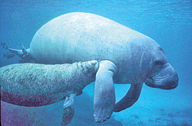
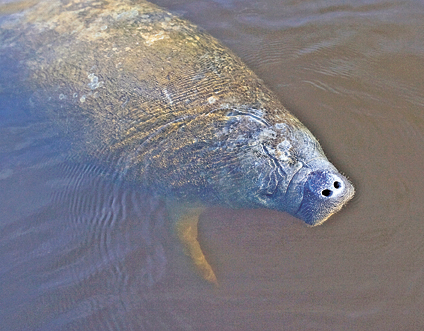
The West Indian manatee is the second-largest member of this order. The female once obtained a length in excess of 15 feet and a weight approaching two tons. Today the average length is 10-12 feet. The other three remaining species are the West African manatee, similar in habits and size to the West Indian; the Amazonian manatee, which inhabits the freshwater system of the Greater Amazonian basin; and the dugong, which has a whale-shaped tail and is more closely related to the extinct Steller’s sea cow.
The closest land-based relatives to the manatee are two very different mammals: the elephant and the hyrax, a rabbit-size herbivore from Africa. The manatee adapted to its salt and freshwater environment beginning in the Miocene period, some 26 million years ago.
The manatee is an herbivore, eating a variety of aquatic vegetation from turtle grass to freshwater reeds. An adult can consume up to 65 pounds of vegetation a day. Because it roots out these grasses, it also consumes vast amounts of sand. This gritty diet wears down its front teeth, which are replaced from back to front throughout its life; the manatee is one of only a few mammal species on earth that has this adaptation. The shark has a similar tooth replacement system, although for different reasons.
Because of its docile nature and the ease with which Homo sapiens have been able to harvest the manatee, all five species have been dramatically impacted by man. Ample archaeological evidence proves that the West Indian manatee has been hunted unabatedly since the arrival of the first Paleo-Indians into Southwest Florida approximately 12-14,000 years ago. This continuous harvesting, until the passage of the Endangered Species Act (1973) and the Marine Mammal Protection Act (1972), has greatly reduced the manatee’s former range and placed the animal on the endangered species red list (vulnerable) of the IUCN.
The meat of the manatee is said to be delicious, similar in texture and taste to the finest cuts of beef (think filet mignon). The Calusa Indians, Cuban fishermen, and early settlers all ate manatee. Native Americans used manatee hide for war shields, canoes, and shoes, the fat for oil, and the bones for “special potions.” Hunting the manatee in the United States was officially banned in 1893, but poaching this gentle giant continues today.
Because of its enormous size, the manatee is almost never taken by sharks, saltwater crocodiles, or alligators. The number-one cause of manatee death is cold water, which results in hypothermia. Florida is the very northern extent of the manatee’s range, and the recent wave of long, cold winters has resulted in the death of hundreds of these gentle giants.
The second leading cause of death is boat collisions. Because of its slow speed and large size, almost every adult manatee in the state has been scarred by boat propellers on its head, back, or tail. Biologists use these ubiquitous scars to identify individual manatees in any given range. Since a manatee swims at less than five miles per hour, it is no match for boats with 300-horsepower engines speeding across an estuary at 60 miles an hour. Laws requiring boaters to slow down in manatee zones are instrumental in saving this species, though they are often ignored by hurried boaters. Another major cause of manatee deaths is red tide.
One reason the manatee population cannot recover easily is the animal’s incredibly slow reproductive rate. It has one calf every two to four years and, depending on availability of mates, may go years without having a calf at all. Although rare, the sea cow will, on occasion, have twins. A highly intelligent mammal, the manatee requires extended nursing periods to teach the calf where to find food, when to migrate to warm waters, and what dangers to avoid.
The combination of a docile nature, slow speed, delicious meat, and low reproductive rate has not been a prescription for success when competing with a smart, fast, and hungry hominoid. Estimates are that between 1,500 and 2,500 manatees are living in the coastal areas of Florida. In 2007 the United States Fish and Wildlife Service attempted to upgrade the status of the manatee from endangered to a lesser, threatened status. There was an immediate outcry from organizations such as Save the Manatee Club, which argued that changing the status would result in far less regulation and would certainly contribute to increased manatee mortality throughout its range.
In winter, one of the best places to see manatees is near the warm outflow of the Florida Power and Light plant off of Palm Beach Blvd. (State Road 80) in North Ft. Myers. Attracted by the warm water, manatees gather by the hundreds in the power-plant discharge canal that flows into the Orange River, a tributary of the Caloosahatchee. Although the water is stained from tannic acid, the chances of seeing one of these rare animals is almost 100 percent as they seek shelter from winter cold fronts from mid-October through the end of March. Go to leeparks.org for a complete printout of hours, directions, and additional information. Manatee Park is also covered in the eco-destination section of this book.
The manatee may well prove to be a litmus test for us. It is what biologists refer to as a “keystone species.” That means that in protecting this docile marine mammal we must also protect the expansive grass flats upon which it feeds. These grass flats in turn support hundreds of additional species, such as sea horses, spotted sea trout, pinfish, tunicates, and shrimp. Like an umbrella, everything beneath the manatee is sheltered from the adverse impacts that seem to follow our every step. Hopefully, 100, or 1,000, years from now and because of our dedication to conservation, someone reading this text will still be able to share their moment in time with West Indian manatees. That cannot be said today about the Steller’s sea cow.
This is an excerpt from Living Sanibel – A Nature Guide to Sanibel & Captiva Islands by Charles Sobczak. The book is available at all the Island bookstores, Baileys, Jerry’s and your favorite online sites.