

Rotary Happenings: Ty Symroski compares Sanibel with Florida Keys
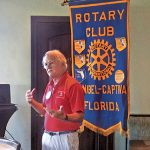
This past Friday, Sept. 9, one of Sanibel Captiva Rotary’s own, Ty Symroski, was the featured speaker. Ty is known to many of the Sanibel community as a long time Sanibel islander. Ty’s maternal grandparents, Ross and Daisy Mayer, came to Sanibel Island in 1919, loading their Model T on a train in Eire, Pennsylvania for winter visits to Sanibel. Eventually they and brother Martin Mayer built Shore Haven and Morning Glories, Sears Kit homes that are currently located in the Sanibel Historical Village.
Ty fondly recalls his visits to Sanibel when growing up, visits during which he absorbed stories about the early life of his family on the island and experienced the island before bridges connected it to the mainline. Ty is convinced that his mother was involved, at the age of 12, in the first automobile accident on Sanibel. Once, when her parents had left for a day trip off island, she decided to get the family mail. Taking her little 7 year old sister with her she “borrowed” the family car and tried to drive it to the post office. She got as far as “a short narrow bridge” when a car suddenly appeared. “Mom freaked out and drove the car off the bridge” was Ty’s statement of what happened next. Ty says that the bridge, which never has more than about six inches of water under it, can still be seen.
It is probably more accurate to say that Ty has been an intermittent long-term Sanibel islander than one who has spent his whole adult life on the island. In 1977 he settled on Sanibel and worked intensively in the planning department as the city implemented the Sanibel Plan. Then, in April 1984, after finishing graduate school, he moved to Key West where he spent the next 30 years working for local and state governments to address the unique environmental and development issues confronting the Florida Keys.
Sanibel-Captiva and the Florida Keys have much in common, but also differ in many ways. There are few people who have experienced and studied both of these island groups as much as Ty. With this in mind we asked Ty to compare and contrast these two popular vacation regions. Ty began by pointing out that the Florida Keys have been a stopover on Western Hemisphere trading routes for many centuries; for most of this time Sanibel and Captiva were backwaters. Both are vacation and retirement centers but the Keys also has a military naval air base as well as large scale commercial fishing enterprises. This may be part of the reason why in Key West most bars close at 4 a.m. Sanibel’s “midnight” comes much earlier, traditionally about 9 p.m. Perhaps the fact that Key West has been a literary haven with authors such as Ernest Hemmingway and Tennessee Williams also accounts for its late night hours.
Judging by when Sanibel’s Rotary and other service clubs meet, typically before or during the workday, most Sanibel residents are morning persons. In Sanibel, development constraints are driven by the goal to preserve the island as a sanctuary. In the Florida Keys the maximum number of persons that can be evacuated in the event of a hurricane guides the amount of housing permits. The Florida Keys, even more so than Sanibel or Captiva, has many endangered species not to mention its miles of coral reefs that are slowly dying due to an adverse environment. Natural diversity is an even greater challenge in the Keys than in Sanibel because unique subspecies have tended to develop on each of its many islands.
Sanibel-Captiva and the Florida Keys have both been severely impacted by building the dike around Lake Okeechobee. The beaches and ecosystem of Sanibel and Captiva are degraded by discharges of massive quantities of water into the Caloosahatchee River from the Lake Okeechobee. The Florida Keys and Florida Bay suffer because of the fresh water that historically flowed south from Lake Okeechobee has been greatly diminished. Importantly, the water that reaches the Florida Bay percolates through many miles of everglades and cypress swamps and this has a major cleansing effect. In contrast, water discharges from Lake Okeechobee into the Caloosahatchee and Saint Lucie rivers that are heavily contaminated retain most of their algae promoting chemicals when they arrive at the Gulf of Mexico and Atlantic Ocean.
As one Rotarian noted in the question and answer session, it seems essential that the prime focus of efforts to deal with this problem should be on moving more water from Lake Okeechobee south to the Florida Bay through systems designed to remove fertilizertype contaminants. This is the only goal that would enhance water quality in the Florida Bay and at the same time achieve relieve the harmful effects to Florida’s West and East Coasts caused by the building of canals that connect Lake Okeechobee to the Caloosahatchee and Saint Lucie river watersheds. Early this year the Sanibel Captiva Rotary hosted Captains for Clean Water where they advocated this so called “Fix-The-Flow” approach to save the sport and commercial fishing industry and protect to quality of our beaches and estuaries in the hundreds of costal miles from Lee to St. Lucie counties.
In 2013, Ty returned to Sanibel where he settled on a large track of land his grandfather bought years ago. Ty works for Tarpon Bay Explorers leading kayak tours and, when off duty from this work, enjoys kayaking through the 20 plus acre kayak swamp that occupies most of his land. Ty joined the Sanibel-Captiva Rotary Club when he returned to our island. He noted, in closing that he was able to accomplish much of his work in the Florida Keys with the help of Rotarians living on the islands stretching from Key Largo to Key West.
The Sanibel-Captiva Rotary Club meets Friday mornings at 7 a.m. at The Dunes Golf & Tennis Club. Guests are welcome.