

Sanibel Sea School flagship campus now offers shell and bird walks
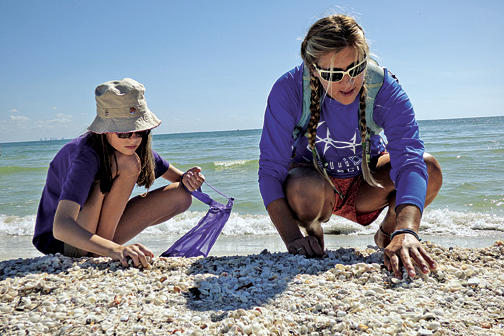
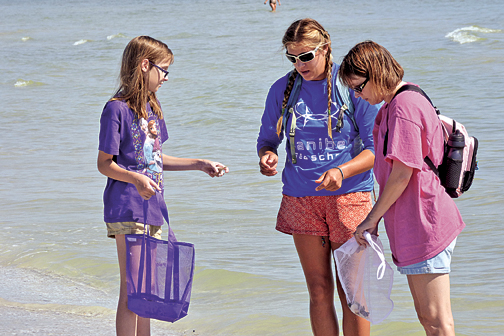
A family on vacation from Pennsylvania gathered at the Sanibel Sea School the second week of November to participate in a shell walk to better understand the shells they were finding on the beaches.
Once everyone introduced themselves and shared their favorite sea animal, Marine Science Educator Spencer Richardson led the group to the beach, all while sharing information about the barrier island. After the short distance to the beach was traveled, she dug a little deeper into why Sanibel is considered the best shelling place in the world, which was followed by a casual stroll along the beach searching for shells.
The Sanibel Sea School began offering a shell walk and bird walk last month at their flagship campus, 455 Periwinkle Way. The shell walk was first introduced to the island at their resort campuses, South Seas Island Resort and Sundial Beach Resort about a year ago.
“It’s really popular at our resort locations and we thought it would do well here, especially during the busy season,” Sanibel Sea School Director of Development Nicole Finnicum said. “We have a lot of inquiries for adult classes and family classes, so we thought we would diversify our offerings here and capture a different audience.”
The bird walk is offered from 9 to 10:30 a.m. and the shell walk from 11 a.m. to 1 p.m. every Thursday year round. Finnicum said they decided to offer both walks on the same day, providing individuals with the opportunity of attending both if they so desired. The walks are $20 per person.
Although the walks are offered at the same times at their resort locations, the days vary. The walks are offered on Captiva, at South Seas Island Resort on Tuesdays, and Wednesdays at Sundial Beach Resort.
The shell walk is a two hour session to provide the Sanibel Sea School staff with the opportunity to really dive into the biology of the shells.
“It’s an overall basic identification course for people of all ages. It’s good for all levels whether they are beginning shellers coming to Sanibel and are interested in learning more about the shell, or whether they are avid shellers and they came specifically to Sanibel,” Finnicum said. “I think Sanibel attracts a lot of visitors who are interested in the shells. This is a good opportunity for us to teach people more about them.”
She said the course talks about the biology of the animal that made the shell, its unique behaviors and whether they are filter feeders, or predatory, how they live, where they live and how they can drill into other shells. The two hours will also touch upon how to identify a shell.
“It kind of blows peoples mind when we tell them these are living animals and these are their skeletons,” Finnicum said. “There are a lot of neat characteristics that each individual shell has when it’s alive.”
The different classes, gastropods and bivalves, are also discussed, she said because it gives people a framework of what they are looking for. Information about egg casings will be discussed, since they start appearing on the beaches in the winter.
“They mate in early winter and the females will start attaching their egg cases to the bottom and then they will hatch, or if we have a big storm they will be dislodged from the sand and wash up on the beach,” Finnicum said. “We see those probably in February through April on the beaches.”
In addition to information shared about the shell, the walk also touches upon why Sanibel is a shelling paradise. Finnicum said barrier islands and its geography are explained, as well as some interesting features of the island that allows the variety of shells.
“We talk about how sand is formed. Most of the sand here is formed from broken up pieces of shells that are eroded into tiny little pieces. It’s a really overall natural history walk on the beach,” she said. “It can be pretty leisurely. We walk around, find a shell and talk about it. Or, we can help people find as many shells as possible. Then people can go home with them.”
Individuals are also taught not to remove live shells from the beach. Finnicum said they teach individuals the difference between a live and dead shell, so they do not accidentally take a live shell home.
“So we can help protect our beaches here and our ecosystem,” she said of why they make sure they spread the message.
Attendees are encouraged to bring their shell bags to the walk. Bags are also available for purchase at the Sanibel Sea School.
The bird walks were first introduced to the island at the South Seas Island Resort campus a few years ago.
“Sanibel is a really great place for birds year round and during the migration season, especially during the fall when birds are coming south and in the spring when the birds are going back north. It’s a great time to learn and see what birds inhabit Sanibel Island,” she said.
The walk touches upon the shorebirds, pelicans, osprey, as well as some of the small perching birds sitting on the wires.
How to identify the bird, its different characteristics, behaviors and other fun facts will be shared.
“A lot of birders come down to Sanibel to vacation here, so it is a great way for them to see the birds we have down here,” Finnicum said.
Attendees will spend time walking inland before making their way out to the beach.
Binocular rentals are offered for those that do not have some of their own.
“We encourage people to come with their questions about their beach finds, or things that they see on the beach,” Finnicum said because their educators are super knowledgeable.
For more information, call (239) 472-8585, or visit www.sanibelseaschool.org.