

‘It’s like Armageddon out here:’ Red tide causes large fish kill
(Editor’s note: This is a developing story. More information will be added as it becomes available.)
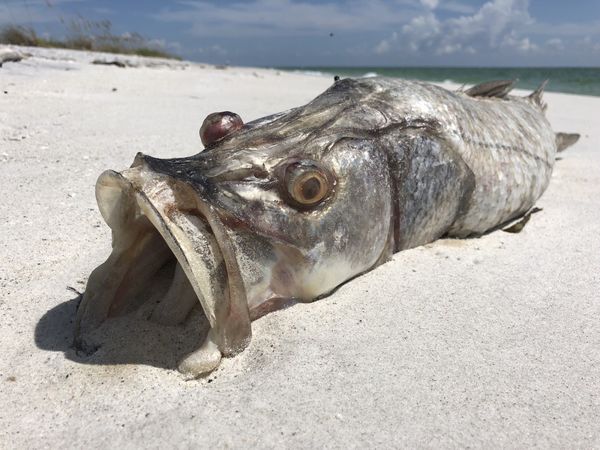
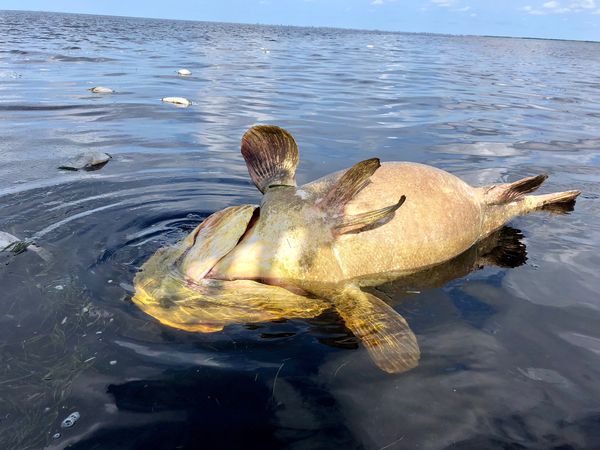
Fishing Captain Rhett Morris ticks off the species he’s watched floating dead in the Gulf of Mexico: snook, tarpon, Goliath grouper, black drum, Spanish mackerel, cobia and a 10-foot manatee.
“It’s like Armageddon out here,” said Morris, a captain for Beyond Borders Outfitters in Punta Gorda.
Morris has been watching the number of fish carcasses floating in the Gulf increase over the last week – and now, he’s seeing it in the Intercoastal Waterway.
The kills are being caused by a red tide bloom that’s been circulating since November, according to MOTE Marine spokeswoman Hayley Rutger. MOTE has sent biologists down to the worst of it, near Boca Grande and Gasparilla Island, to investigate. Fish counts are not yet available.
Morris said he first saw the fish kill start around June 10, and didn’t think much about it. Red tide and fish kills go hand in hand, and what he was seeing near Little Gasparilla Pass wasn’t “too crazy,” he said.
But then, it got crazy.
On June 21, Morris went back out to the pass to find an eight-mile line of dead snook. The fish had tried swimming back out to the Gulf to escape the bloom – but it caught up to them, he said.
What was even worse was that snook, a popular sport fish, are in spawning season. Many of the dead fish were laden with eggs to produce the next generation.
“I’ve been out here 25 years. I’ve never seen anything remotely in the ball park,” Morris said.
He even saw what he estimated to be a 400 to 500-pound Goliath grouper, a victim of the red time bloom. A fish of that size could be 20 years old.
“I’ve never seen a Goliath in red tide,” he said. “That fish has lived through so many red tide events, and this one wiped it out.”
The red tide stretched from Captiva to Sarasota, but its epicenter is Boca Grande to Gasparilla. Rae Burns, environmental technician from the Town of Fort Myers Beach, said Fort Myers Beach is in the clear. There have been no fish kills and no positive tests for red tide.
Captains like Morris have been trying to avoid the red tide areas – but fishing hasn’t been good elsewhere, either.
“I’ve canceled quite a few trips,” he said. “Fishing has been terrible.”
Daniel Andrews, a fishing captain and co-founder of Captains for Clean Water, said the fish kills and red tide are hitting all the water-based industries in the area most affected.
The kill-off of spawning snook wasn’t an “insignificant number,” he said. He’s hoping enough snook could swim south, away from the red tide, to survive and spawn.
Rutger said the duration of this red tide is notable, but not necessarily the first one to endure this long.
“It’s hard because the data collection methods get better,” she said. “We don’t have the same data set for the last 20 years.”
MOTE has seen periods of high red tide counts before in its Sarasota testing area, in 2005. Then it lulled until 2017.
Red tide feeds itself, making it a tricky algae, Rutger said. Nitrogen and phosphorus from a variety of sources – including fertilizer run off – can feed the organism.
MOTE now has a smart phone app called CSIC where people can report red tide, fish kills, discolored water and more, and mark their location on a map.
“We try to make sure people have the tools they need to plan their days,” she said. “Any red tide that effects us or our fish is challenging, there’s no question.”
Morris is getting ready to make a stand in his own way. He and other captains formed a group called Save Our Florida Fisheries. On July 14, the group and any other interested activists are planning a “convoy” of cars with banners and messages starting in Punta Gorda and looping down through Alligator Alley and then back up to Lake Okeechobee for a press conference.
“I’ve been beating this conservation drum for 20 years,” Morris said. “In the last four to five years, people seem to finally understand we have issues.”
He’s hoping the Florida Fish and Wildlife Conservation Commission will get the message that the industry generating more than $80 billion in economic revenue for the state is suffering from the red tide and other environmental issues.
“I think the FWC are paying attention,” he said. “Enough is enough.”