

CCP consultant to begin research on issues voiced in workshops, survey
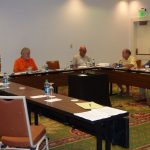
The Captiva Community Panel gave the green light for a consultant to proceed with research over the summer on a narrowed down list of issues raised by islanders as part of the Captiva Code update.
At its June 12 meeting, the panel voted 7-1 to finalize the list of concerns to be examined, which property owners brought up through public workshops and an online survey. Max Forgey, with Forgey Planning, will determine how similar communities addressed, prohibited or limited the problems.
“We’re trying to get the list of 46 down,” Administrator Ken Gooderham told the panel.
A tentative list of 25 issues – plus an additional six concerns that were raised by respondents in the open-ended and comments sections of the survey – was presented at the meeting for approval.
Gooderham explained that the cuts involved preemptive legislation that the panel cannot change, concerns that ranked lowest on the priority list for the public and issues that they did not care about.
Some issues deleted from further research included maintaining the 1978 Coastal Construction Line because of the recently passed change to create a Coastal Construction Setback Line, and speeding on Captiva Drive due to a recent Lee County Department of Transportation analysis reflecting no issue.
In addition, concerns such as children driving golf carts and proliferation of prohibited sandwich signs were removed because there are laws and regulations in place, so it is more of an enforcement issue.
A couple of the issues to remain on the list are dune vegetation protection, beach cleanup overall and plastic straws on beaches, overcrowded rental houses, septics, and preserving the dark night sky.
Panel Member Rene Miville questioned why outside speakers and televisions made the cut.
He pointed to the island’s current noise ordinance and asked what else could be done.
“I think we’re trying to see if someone else has come up with a better way of dealing with that,” Gooderham said.
Panel Member Mike Lanigan questioned the methodology and proposed final list.
“I think we’re elevating a number of these,” he said, adding that he thought several concerns needed to be removed before any approval. “There are a number of items on the list that were in the tubes.”
Lanigan pointed to limits on or transition from gas-powered leaf blowers.
He also questioned why six additional written-in concerns, such as architectural and landscape guidelines or regulations to maintain Captiva’s island style – automatically made the cut.
“I don’t think we should get into the business of telling people what they can put up on their lot,” Lanigan said. “I don’t think it exists, I think freedom of expression does, and I want to encourage that.”
Panel Member Bob Walter agreed, comparing it to being a homeowner’s association.
Gooderham and President David Mintz, who was attending via a conference call, explained that the concerns raised in writing were given weight because it took people more time to share those opinions.
“The ones that were eliminated were eliminated because there are other ways to approach them,” Mintz reiterated.
He added that the panel can decide in its future discussions what to do about an issue.
“We can reject them outright, we can have a debate,” Mintz said.
Forgey outlined his research approach for the panel, which will include identifying any related Lee County regulations in existence and examining about a dozen coastal governments on their approach.
“Our goal is to come back with, ‘Here is what you need to know on deliberating on this (issue),'” Gooderham said. “We’re trying to get you some information to have that discussion.”
Lanigan was the sole dissenting vote on the motion to proceed.
The results of the summer research are expected to be presented in September.
IGUANA CONTROL
Gooderham reported that he spoke to the Captiva Erosion Prevention District and Lee County.
“There’s no one at the county that handles iguanas,” he said.
It was suggested that a taxing authority be set up to pay for iguana control services.
“I would do a taxing district as a final resort,” Gooderham said.
He reported that Boca Grande created a taxing unit and most of the property owners pay into it.
“It is a good way to deal with in, but the process does take time,” Gooderham said.
Panel Member Dave Jensen said he would talk to the trapper Sanibel uses.
“Maybe he can come up with a program,” he said.
REGIONAL VESSEL THEFTS
Lee County Sheriff’s Office Lt. Mike Sawicki reported that there has been an uptick in boat thefts regionally. He offered up several tips for keeping boats safe, including removing the safety key for ones on lifts, installing motion sensor lights and even surveillance cameras, and installing a GPS tracker.
“Place them somewhere where you can actually see somebody’s face,” Sawicki said of cameras.
Boats stored in canals should be visible to neighbors and deputies. If storing for an extended period of time, remove the steering wheel. He suggested disconnecting the battery and installing a boat alarm.
“Yamaha motors are really hot right now,” Sawicki said.
For boats stored on trailers, he recommended chaining the wheels together.
“We want to make it where they just bypass Captiva completely because we make it tough,” he said.
Other tips included engraving the driver’s license number and state on the boat, taking photos of all valuable items left on the vessel and making copies of ownership papers and related documents.
Sawicki also advised against leaving fishing and diving equipment in plain view.
“All it takes is for someone to recognize that’s an item of value and it takes 10 seconds for them to take that off the boat,” he said.
IN OTHER NEWS
– Lanigan reported that the Communications Committee sent a list of edits to the web developer. He anticipated that the panel’s new website will be completed and launched within two weeks.
“We’d really love some feedback, if people could go to the site,” he said.
Secretary Mike Mullins noted that a social media presence and newsletter are future ideas.
“We’d like to get something like that initiated this year,” he said.
The panel’s site is at www.captivacommunitypanel.com.
– Treasurer Tom Rathbone reported that the panel has approximately $119,282 in its fund. He suggested that the panel move the money into an interest-bearing account at some point.
“Now that interest rates are up,” Rathbone said.
– Captiva Island Fire Control District Fire Chief Jeff Pawul reported that it is the district’s responsibility to provide information during a hurricane. In the past, it tried to rely on volunteers to help provide the information, but volunteers tend to evacuate or not be present at the time.
Last year, the district used its website and news conferences to get information out.
“It’s going to work kind of the way it did last year,” Pawul said.
He added that a public information officer position will not be created. The spreading of important information – not what stores are open on-island – will be the duty of the head staffer on each shift.
Pawul noted that the district started using Twitter last year to disseminate the information.
“We are going to try and utilize that type of social media more in the future,” he said.
Walter shared that South Seas Island Resort has an 800 number set up that people can call for information during a storm. The details are updated twice a day, at 10 a.m. and at 10 p.m.
“We did that and it worked out,” he said.
– CEPD Administrator Damon Grant reported that staff received calls last week about red tide offshore and that it was particularly noticeable on June 7. As of the meeting, no dead fish had been observed.
“We’ll keep an eye out for fish kills as a result of that,” he said.
Grant noted that the CEPD can tap into county funds to have fish kills cleaned up.
“This would all be contracted labor,” he said.
Grant recommended that anyone who observes a fish kill contact the CEPD at 239-472-2472.
“If we could be the gatekeepers of that, I think that would be appropriate,” he said.
Grant shared that the CEPD’s budget hearings are set for Sept. 13 and 27.