

Consultant reviews Captiva zoning, land use with members of panel

As task one of his four-part contract with the Captiva Community Panel, local planning consultant David Depew outlined the zoning and land use issues facing the island during a recent briefing.
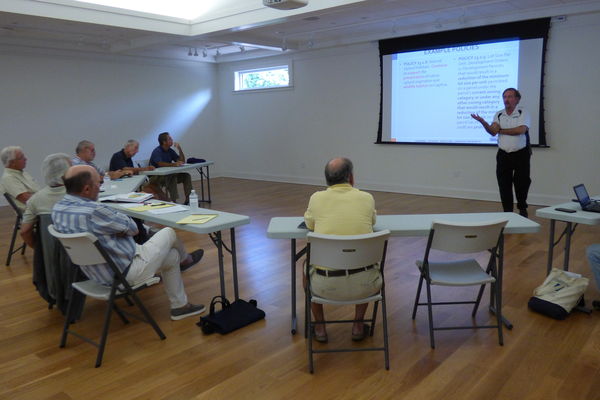
On April 24 at the Captiva Community Center, Depew spoke before the panel and a handful of community members who attended. The presentation covered land code writing, rezoning processes and the use of variances and special exemptions, Captiva’s zoning districts, and potential issues.
Depew emphasized the importance of a community getting its code right on paper.
“I almost do nothing but go to court now,” he said, referring to situations when communities have to fight to protect their written code or parts of it. “You don’t want to go there. It’s hugely expensive.”
Depew added that the outcomes are typically not good for any of the parties involved either.
He offered guidance when it comes to writing code, if the panel wants to make changes.
“You’re got to write them like this – no wiggle room,” Depew said.
He recommended leaning toward specific language and wording over general terms.
In the process of updating the Captiva Community Code, the panel scheduled public workshops to obtain input from the community on a range of potential island-related issues. All property owners on the island were also asked to take part in an online survey so the panel could gather extra feedback.
The panel will use the data to offer recommended changes to Lee County regarding the code.
The decision on implementing the suggested changes lies solely with the county.
President David Mintz explained that when the panel was working with Lee County on updating the Captiva Community Plan, which was recently approved, staff pushed them toward general terms.
“We had to fight tooth and nail for that,” he said of specific language for height provisions.
Mintz asked Depew if the panel should revisit the plan and flush out other sections.
“We have a lot of legacy provisions, and even some new provisions, that we had to compromise on,” he said.
Depew advised that it might be worth re-examining those sections of the plan. He recommended against cementing things so much so that they cannot be changed as future advancements are made.
“Leave yourself a little bit of a pressure value,” he said.
Depew explained typical rezoning processes, like planned development and conventional. He noted, however, that the panel may likely find itself working more with variances or special exceptions.
“It doesn’t go to the county commission,” Depew said. “It goes to the hearing examiner.”
He reported that most of Captiva is marked as “outlying suburban” on the future land use map.
“You have a bunch of zoning categories out here,” Depew said.
He broke down for the panel each of the zoning districts found on the island, along with the property development and use regulations for each, the history behind each zone categorization and more.
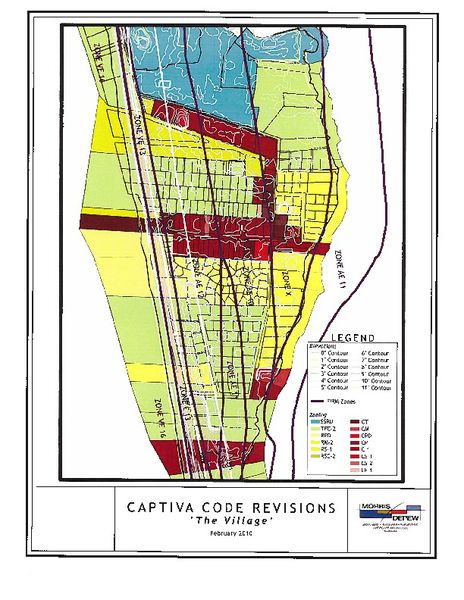
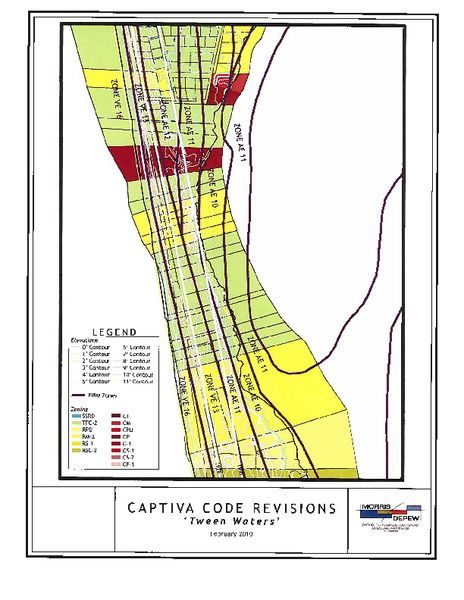
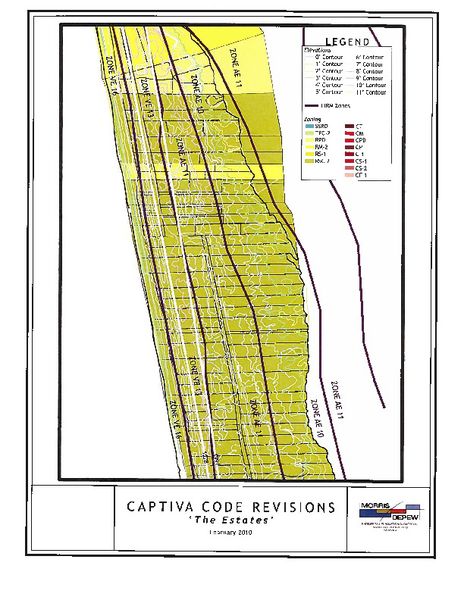
Depew also focused in on separate areas – The Village, ‘Tween Waters and The Estates.
Some of the points he reported on:
– Lots in the residential single-family estate district can have three dwellings, a main house and two “accessory” dwellings for family or guests, which should not be used in the “vacation rental program.”
– Due to regulations associated with two-family conservation district, he described the best case scenario as a single-family home on each lot; worst case scenario would be a duplex on each.
– Andy Rosse Lane is one example of a commercial district that allows for both residential and commercial uses; Depew pointed out that it was one of the first types of mixed use districts.
– Special commercial office districts are intended to be for “low volume” office use.
– A tourist commercial district allows for multifamily housing uses, as well as allows for “accommodations and services for tourists and other visitors and short-term or seasonal residents.”
He pointed out The Village for the panel members.
“It’s this area here that’s the most concern because that’s where you have a lot of odd zoning districts,” Depew said.
He next focused on three specific properties as examples, going over what they are currently being used for and what is on them, what is permitted based on the district and any potential problems.
The Rauschenberg property has nearly 11 acres of residential single-family district and almost 10 acres of residential two-family conservation district, along with about two acres of commercial district.
“That’s a huge asset that’s sitting there,” Depew said of the residential single-family.
“That’s before we even talk about the TFC-2 property,” he said.
Depew explained that based on the district uses, the property could be turned into homes if the land was sold. As long as the new owner adhered to the lot and density requirements, it could be done.
Attempting to rezone it for a planned development is also possible, but a tough fight.
The Jensen’s Twin Palm property boasts just over one acre of residential multi-family district.
He explained that 14 dwelling units currently exist on the property, but a density limitation of three units per acres has been set since then. If a hurricane were to hit, repairs could be made to maintain the existing 14 units using the 50 percent rule or they could be torn down but only three new units built.
Depew also pointed out McCarthy’s Marina, noting that the property is not a concern.
“You’re only looking at two units if the marina disappears,” he said.
The South Seas Resort District was also briefly discussed.
Depew encouraged the panel to stick to its guns.
“You have to continually expel energy on pushing the county to do what you want,” he said.
In April, the panel unanimously approved hiring Depew as a consultant for $9,750.
His purpose is to review the island’s new plan and assist the panel with its ongoing work of updating the code. The idea behind hiring Depew was for him to help the members with bulletproofing it all.